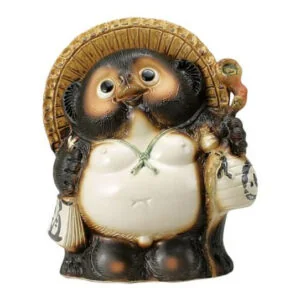
Outside Japanese restaurants and shops, one statue keeps appearing: a plump, pot-bellied animal in a straw hat, a sake bottle in one hand and a ledger in the other. This is the Tanuki, a shapeshifting yokai that is at once a bon vivant, a prankster and a good-luck charm. Behind the figurine lies a real animal and a rich folklore. Here's what the Tanuki is, what each detail of its statue means, and why it's so often confused with the badger or the fox.
The animal behind the yokai
The Tanuki is first of all a real animal: the Japanese raccoon dog (Nyctereutes viverrinus), a stocky canid with grey-brown fur and a dark facial mask that makes it look like a raccoon, though it isn't one. It's that round face and nocturnal habits that made it a folklore character. In the legends, the Tanuki becomes a bake-danuki (化け狸), a shapeshifting Tanuki able to take human form or turn leaves into fake money to fool merchants. Unlike the Kitsune, cunning and sometimes dangerous, the Tanuki is clumsy, jovial and good-natured: its tricks often backfire on itself.
Read the guide to yokai · See Japanese masks
The statue and its eight symbols
The Tanuki figurine, popularised by Shigaraki pottery, is codified. Each of its eight attributes (hassō) carries a meaning tied to luck and success, especially in business.
| Attribute | Meaning | |-----------|---------| | Straw hat | Protection from trouble and bad weather | | Big eyes | Perceiving the surroundings and making good decisions | | Sake bottle | Virtue and good food | | Ledger | Trust and reliability in business | | Big belly | Calm and considered decisions | | Large tail | Stability and strength through to success | | Money pouch / coin | Financial luck and prosperity | | Smile | Friendliness and a warm welcome |
That's why a Tanuki is placed at the entrance of shops: it invites fortune, trust and good cheer.
The Tanuki's famous assets
You can't discuss the Tanuki without the most surprising detail of its imagery: its exaggeratedly large testicles. Far from a bawdy joke, this motif comes from a craft reality. Japanese goldbeaters wrapped gold in Tanuki skin to hammer it into very thin leaf, because the skin resisted stretching. A small piece of gold could thus be "stretched" over a large surface. By wordplay and symbol, the Tanuki became a figure of expanding wealth, the kin no tama ("ball of gold") playing on the idea of "stretching your money." It's a symbol of prosperity, not vulgarity.
The Bunbuku teapot legend
The most famous tale is Bunbuku Chagama, "the teapot that spreads happiness." A poor man frees a trapped Tanuki. Grateful, the animal turns into a fine teapot for the man to sell to a temple. But when the monk sets it to heat, the teapot, unable to bear the heat, sprouts legs, head and tail and runs off, half teapot, half Tanuki. The man and the Tanuki end up putting on a little show with this dancing creature and make their fortune together. The moral is pure Tanuki: gratitude, resourcefulness, and good fortune shared.
Tanuki or Kitsune?
The two great shapeshifters of folklore are often confused. The Kitsune (fox) is elegant, intelligent and calculating, messenger of the kami Inari, capable of cruel tricks. The Tanuki is round, jovial and clumsy, tied more to pleasure, sake and luck than to the sacred. Both belong to the wider family of shapeshifting yokai, but embody two opposite temperaments: cold cunning on one side, warm good humour on the other.
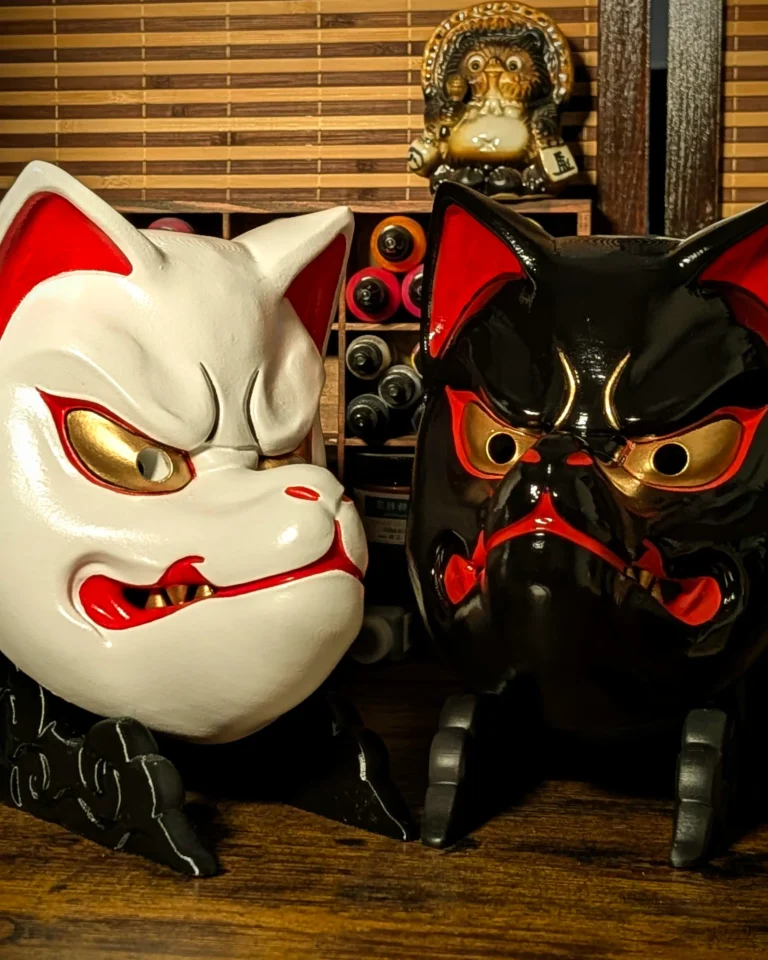
Read the article about Kitsune · See Kitsune masks
FAQ
What is a Tanuki?
The Tanuki is both a real animal, the Japanese raccoon dog, and a shapeshifting yokai of folklore. In the legends it takes human form, plays tricks, and symbolises luck and prosperity, especially as a good-luck statue.
Is the Tanuki a raccoon or a badger?
Neither. It's a canid, the Japanese raccoon dog (Nyctereutes viverrinus), related to the fox and the wolf. Its dark facial mask makes it look like a raccoon, but it isn't one.
Why does the Tanuki statue have large testicles?
It's a symbol of prosperity, not a joke. Goldbeaters wrapped gold in Tanuki skin to stretch it into thin leaf. By wordplay, the Tanuki became a figure of expanding wealth.
What's the difference between Tanuki and Kitsune?
The Kitsune is cunning, intelligent and tied to the sacred as Inari's messenger. The Tanuki is jovial, clumsy and tied to pleasure and luck. Two shapeshifters with opposite temperaments.