In Japan, a cat that lives too long can turn into a yokai. Two creatures embody this belief: the Bakeneko (化け猫, "changing cat") and the Nekomata (猫又, "forked cat"), often confused but quite distinct. Behind these legends lies a very concrete observation of cats by the Japanese of old, and a healthy dose of suspicion. Here's what these supernatural cats are, their powers, and how to tell them apart.
Bakeneko: the cat that changes
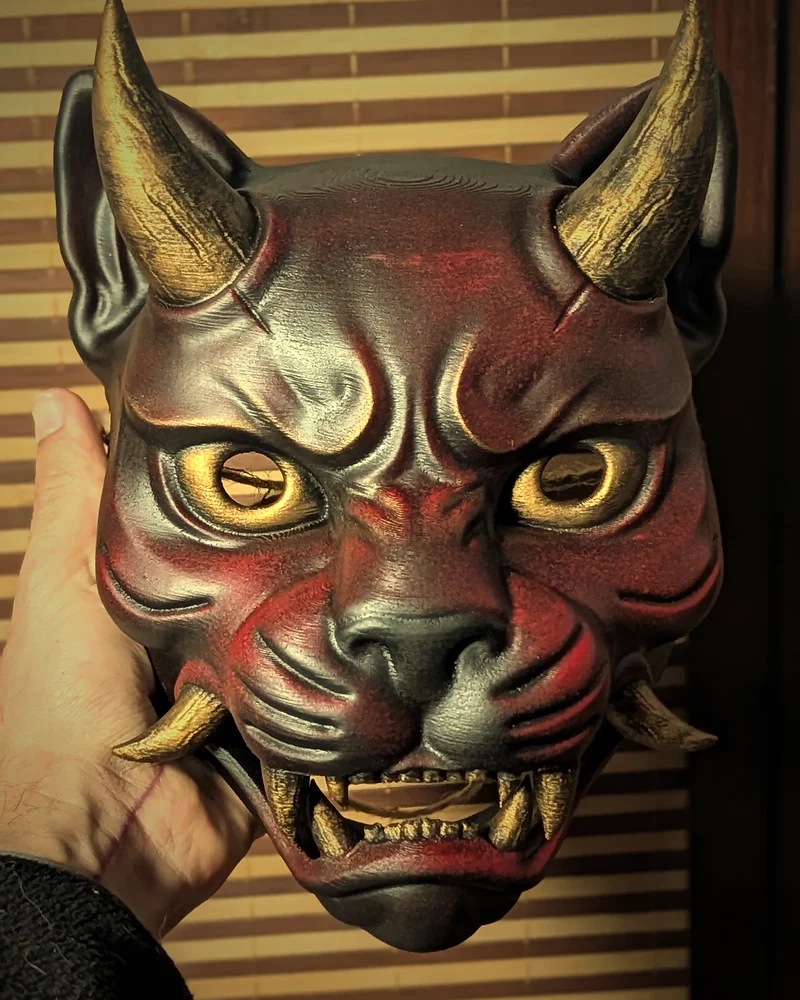
The Bakeneko is an ordinary cat turned supernatural, usually because it has lived very long, grown large, or reached a certain weight. Old beliefs credit it with several powers: standing on its hind legs, speaking human language, taking human form, and manipulating fire, which is why cats were sometimes blamed for house fires. Some tales describe it devouring its own master to take their place and live disguised as them. The distrust of long-tailed cats came partly from this: people sometimes cut kittens' tails to stop them becoming yokai.
Read the article about Nekomata and Bakeneko · See the Nekomata mask
Nekomata: the cat with the split tail
The Nekomata is the more fearsome evolution. Its name, "forked cat," comes from its distinctive trait: a tail that splits in two. It exists in two forms. The mountain Nekomata is a large wild beast, almost a giant feline, said to live in remote forests. The household Nekomata is an old house cat whose tail has forked with age, developing necromantic powers: it's said to be able to reanimate and control the dead, like a puppeteer working corpses. It's this link to death that makes it a far more disturbing yokai than the Bakeneko.
The difference, clearly
The confusion is common, but the distinction comes down to a few points.
| | Bakeneko | Nekomata | |---|----------|----------| | Tail | Normal | Split in two | | Origin | Aged cat turned supernatural | More advanced stage, or mountain beast | | Key power | Shapeshifting, fire, speech | Control of the dead, necromancy | | Danger | Deceptive, vengeful | More powerful and sinister |
In short, every Nekomata was first an ordinary cat, but not every supernatural cat is a Nekomata. The split tail is the visual marker that separates them.
Why these legends?
Beliefs about cat yokai say a lot about Japan's ambiguous relationship with the cat. Valued for hunting the rodents that threatened rice and silkworms, the cat remained a nocturnal, silent creature with eyes that glow in the dark and an independent, unpredictable nature. This ambivalence is typical of yokai: a useful, familiar presence that tips into the uncanny the moment it slips human control. The same logic runs through the Kitsune, by turns sacred messenger and wild trickster. The maneki-neko, the beckoning lucky cat, is in a way the bright flip side of this same belief.
FAQ
What's the difference between Bakeneko and Nekomata?
The Bakeneko is a cat turned supernatural, with a normal tail, able to shapeshift, speak and manipulate fire. The Nekomata is a more advanced stage, recognisable by its split tail, with power over the dead. The split tail is the key marker.
Why does the Nekomata have a split tail?
Its name means "forked cat." Belief holds that a very old cat's tail splits in two as it becomes a yokai. It's the visible sign of its transformation and supernatural powers.
Are cat yokai evil?
They're ambivalent, like most yokai. Deceptive and sometimes vengeful, they can also be loyal to a kind master. The Nekomata, tied to necromancy, is markedly more disturbing than the Bakeneko.
Where does the belief in supernatural cats come from?
From observing cats: nocturnal, silent animals with glowing eyes and independent behaviour. Useful against rodents but hard to read, they inspired a mix of affection and suspicion.