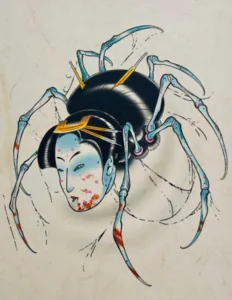
The Jorogumo (絡新婦) is a yokai of Japanese folklore: a Nephila clavata spider that, after 400 years, gains supernatural powers and turns into a stunningly beautiful woman to hunt men. She plays the biwa to entrance them and weaves invisible silk around them. She never kills fast: she builds trust, then closes the trap. Here are her legends, how to tell her from the Tsuchigumo, and her place in irezumi tattooing.
Key takeaways
- A 400-year-old spider transformed into a woman to trap men
- Her name has two readings: "harlot spider" (女郎蜘蛛) and "binding bride" (絡新婦)
- Not to be confused with the Tsuchigumo (土蜘蛛), the giant male combat spider
- A powerful irezumi motif: beauty, arachnid horror and strategic patience
The real spider exists: the Trichonephila clavata, common in Japan, 2 to 3 cm of body, yellow-and-black markings, a web strong enough to catch small birds. When a web can trap a bird, imagining it trapping a man isn't much of a leap.
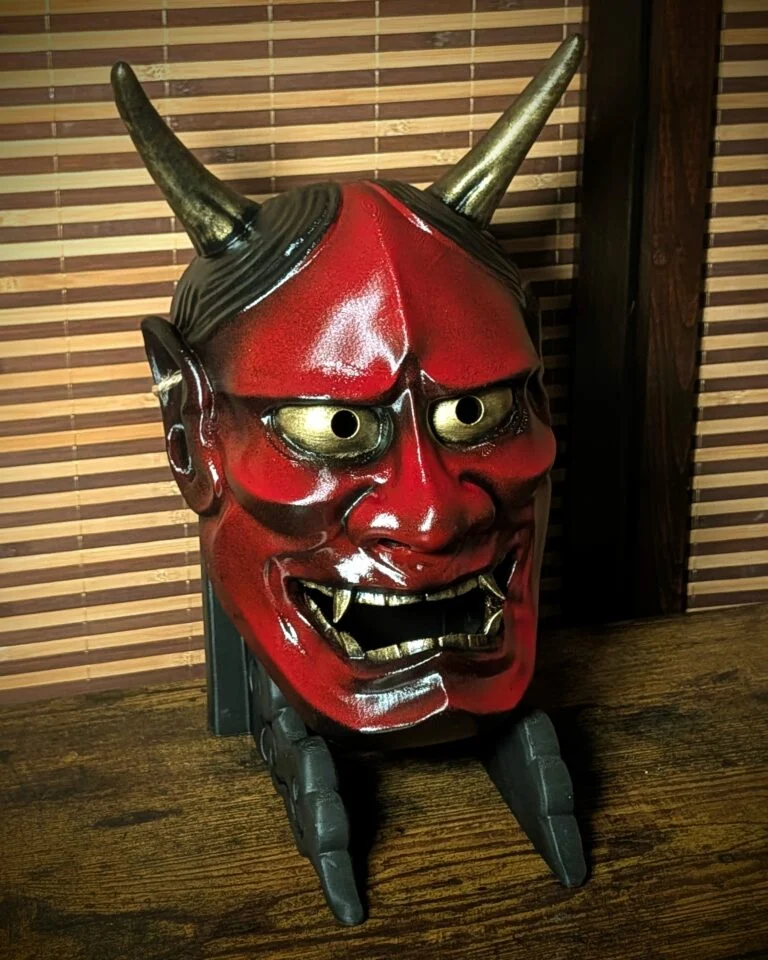
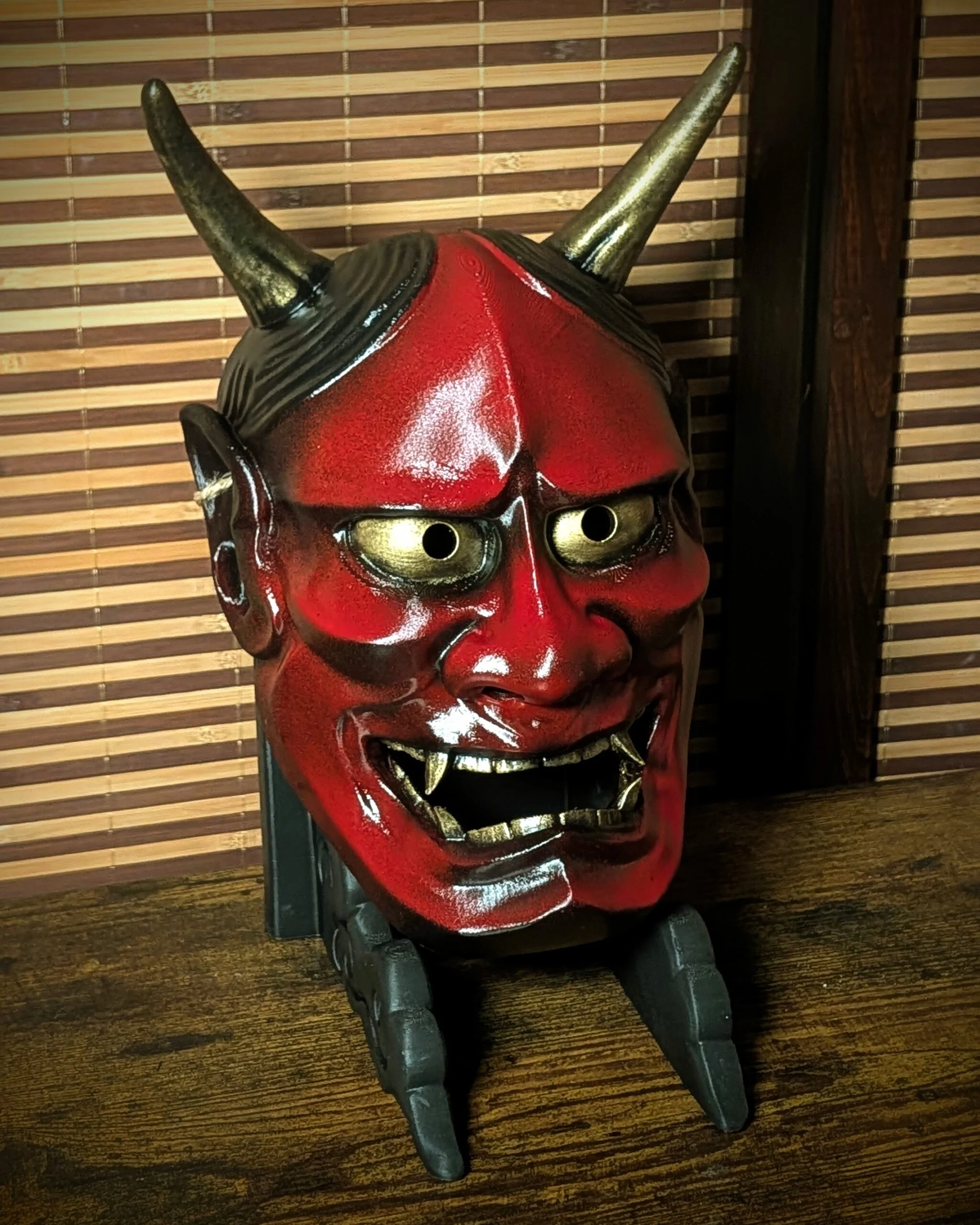
Read the article about Oni masks · See Oni masks
Why two names for one creature?
The name Jorogumo has two readings, a deliberate Edo-era pun. The first, 女郎蜘蛛, "harlot spider", describes what the creature does. The second, 絡新婦, "binding bride", describes how she does it. One word holding both beauty and horror, a mechanism you find all over the folklore: the Hannya mask is both a woman's face and a demon's, depending on the angle.
The three great legends
Jōren Falls (Shizuoka). A woodcutter drops his axe into the falls' pool. A woman of unearthly beauty returns it. He comes back daily and weakens. A monk sees the trap: she's a giant Jorogumo draining his life, and sutras break the hold. To this day, Izu locals warn against getting too close to the Jōren Falls pool.
The fisherman of Kashikobuchi (Sendai). A fisherman notices a spider winding a thread around his leg. Instead of panicking, he unties it and loops it around a tree. The tree is yanked into the river. A voice rises from the water: "Clever, clever." In this version the Jorogumo is also venerated, locals keeping a cult to appease her. In Japan, dangerous beings are often worshipped precisely to avoid their wrath, as with the Oni.
The baby trap (Tonoigusa, Edo era). A beautiful woman meets a warrior, a baby in her arms: "Look, here's your father." When he takes the baby, it's a sac of spider eggs hatching at once, hundreds of spiderlings pouring over him. The most vicious version: it exploits paternal instinct, not seduction.
Jorogumo or Tsuchigumo: how to tell them apart
Folklore has two major spider-yokai, radically different.
The Tsuchigumo is the combat boss. The Jorogumo is the manipulation boss. Two takes on the same mythic material.
The Jorogumo in irezumi tattooing
The Jorogumo is a powerful irezumi motif, blending feminine beauty, arachnid horror and rich symbolism. On the skin she speaks to the danger of seduction (beauty as a trap), feminine strength (claiming a power of transformation, a direct echo of Yasuzo Masumura's 1966 film Irezumi), strategic patience, and sometimes protection over water (the Kashikobuchi variant). Classic compositions: Jorogumo playing the biwa across a full back with a waterfall and golden silk; half-woman half-spider on a sleeve or thigh; a woman's face with legs under the kimono on a forearm, Toriyama Sekien style.
That first catalogued image comes from Sekien (1712-1788) in his Gazu Hyakki Yagyō (1776): an elegant woman whose kimono hints at spider legs. Its power is in what it doesn't show. No obvious monster, just a woman with one unsettling detail. That's the Jorogumo exactly: the danger is only visible if you look closely.
The link to the "demon women" masks
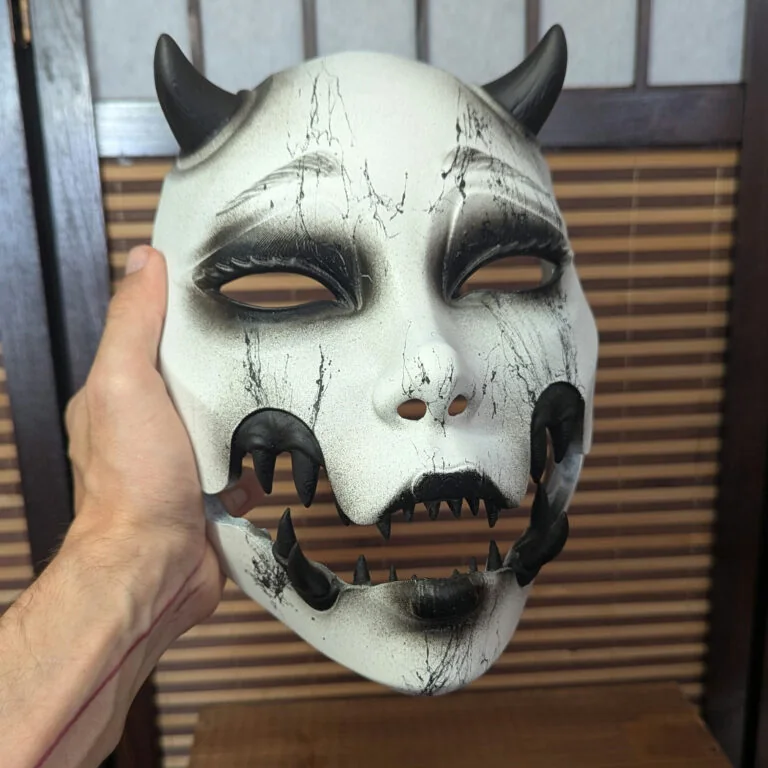
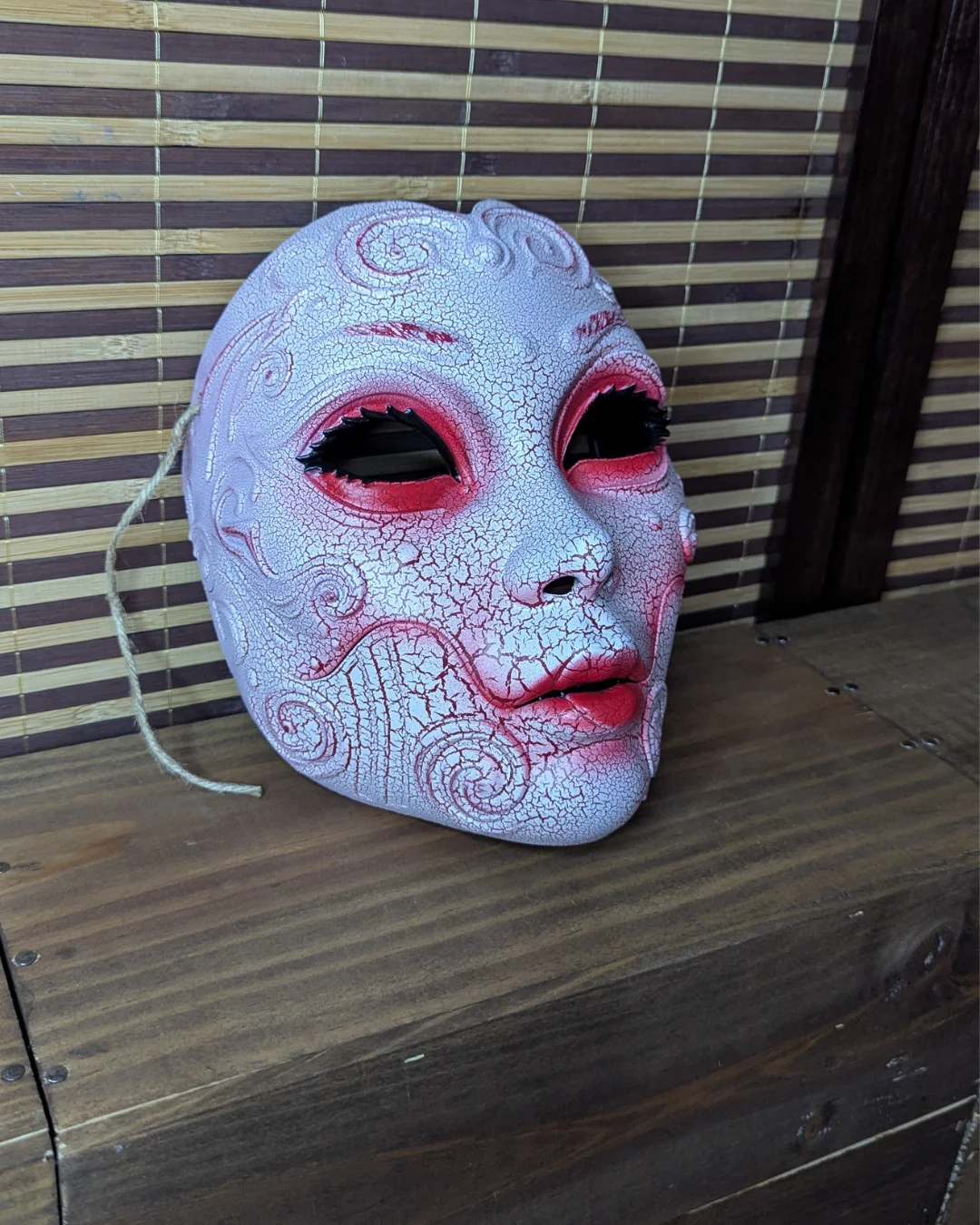
The Jorogumo embodies the idea of a mask in the literal sense: a beautiful face hiding a monstrous nature. It's the exact mechanic of the Geisha Horror articulated mask, a geisha face whose jaw opens onto something far less reassuring. The Kuchisake-onna articulated mask pushes it further: the mouth literally opens. And the Hannya shares the core theme, a woman warped into a demon by suffering. The Jorogumo seduces then devours; the Hannya loves then consumes herself.
FAQ
What's the difference between Jorogumo and Tsuchigumo?
The Jorogumo is female: seduction, music and patience to trap men. The Tsuchigumo is male or neutral and attacks with brute force. The Tsuchigumo is best known for fighting Minamoto no Raikō, who kills it with the blade renamed Kumo-kiri ("spider-cutter").
Is the Jorogumo real?
The Trichonephila clavata spider exists in Japan: 2 to 3 cm, yellow-and-black markings, webs strong enough to catch small birds. In Japanese, "Jorogumo" names both the yokai and the real species.
How do you spot a Jorogumo disguised as a woman?
In the Edo legends, she's too perfect to be natural. The only reliable tell is her reflection: even in human form, a mirror shows her spider shape. Her legs stay hidden under a long kimono.
Which Dai Yokai mask fits the Jorogumo theme?
The articulated Geisha Horror is the closest: the same deceptive beauty and horrifying reveal. The articulated Kuchisake-onna explores the same "opening face" mechanic.
Is the Jorogumo one of the female yokai?
Yes, she's one of the five great "beautiful and deadly" figures of the folklore, alongside Tamamo no Mae, Yuki-onna, Kuchisake-onna and Hannya. All embody the bake-bijin, beauty hiding danger.