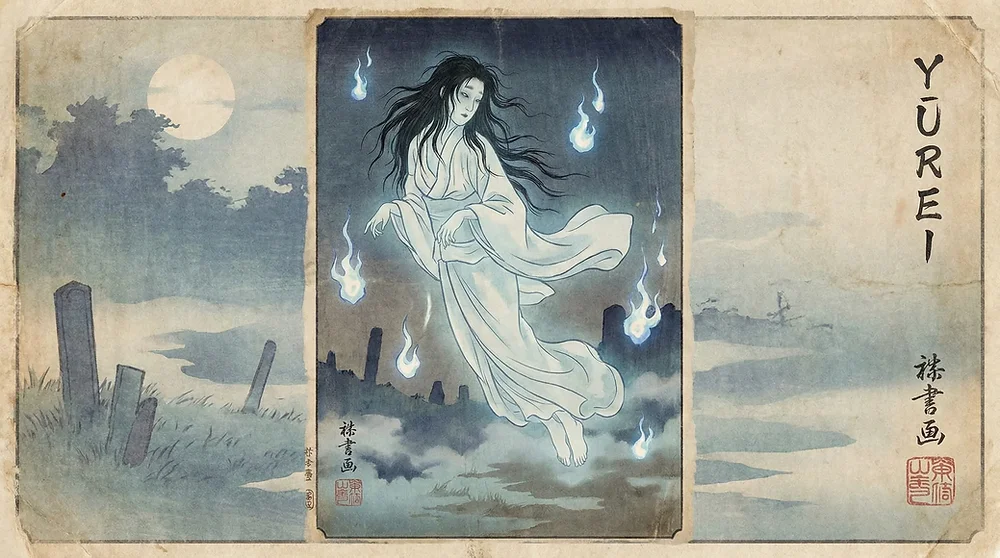
The yūrei (幽霊) is the Japanese ghost: yū (幽), the dim and imperceptible, and rei (霊), the soul. Unlike yokai such as the Oni or the Tengu, which are creatures, the yūrei was once human. It lingers among the living because it left something unfinished: anger, often, but also a love or a regret too strong to be put out by death. This guide explains what a yūrei is, what it looks like, its main categories, and how Japan lives with its dead.
Read the article about Oni masks · See Oni masks
What holds a soul back
In Shinto thought, every person has a soul, the reikon. At death, once the funeral rites are done, that soul joins its ancestors and becomes a protective spirit, the sorei. But if death is violent (murder, suicide, war) or the rites aren't performed, the soul stays stuck between the two worlds: it becomes a yūrei. So it isn't evil that creates a ghost, it's the unfinished.
A codified look
Look at an 18th-century ghost painting and you'll always recognise the same traits. The yūrei wears the kyōkatabira, a white burial kimono folded right over left, the opposite of the living. On the forehead, a small white triangle of cloth, the hitaikakushi, a headpiece for the journey to the afterlife. It has no feet: the hem of its kimono fades into mist, a sign it's no longer bound to the earth. And its hands often hang, wrists limp, in a posture of helplessness. The absence of feet is a convention set by the painter Maruyama Ōkyo in the late 18th century, the norm ever since.
The candy-buying mother
The most moving yūrei story is that of the candy-buying mother (kosodate-yūrei). Every night a very pale woman comes to buy a sweet from a merchant, paying with a small coin, then, out of money, with her own kimono. Intrigued, the merchant follows her to a graveyard, where she vanishes by a fresh grave. They dig, and find the woman dead in childbirth, her infant alive in her arms, sucking the sweet she had bought to keep it alive. It's the perfect example of the ubume, the ghost of a woman who died in childbirth, held back not by hatred but by a mother's worry.
The main categories
Not all yūrei are alike. The sorei is the appeased ancestor, turned protector of the family. The ubume is the tragic mother, consumed by love for her child. The onryō is the pure vengeful spirit, born of rage, striking without distinction: these are the ghosts that inspired Sadako (Ring) and Japanese horror cinema. And the goryō is the spirit of a noble who died unjustly, able to cause disasters but who, once appeased by rites, becomes a protective deity. Whether a ghost is frightening or benevolent depends less on its nature than on the rites performed.
Obon: the festival of reunion
To understand the Japanese relationship with the dead, you need Obon, in mid-August. Ancestors' souls are believed to return to visit their families. It isn't frightening, it's joyful: graves are cleaned, welcome lanterns (mukaebi) and farewell lanterns (okuribi) are lit, sometimes set adrift on rivers. Two mounts are even made from vegetables, a cucumber horse so the ancestor comes quickly, an eggplant cow so it leaves slowly, loaded with offerings. Here the yūrei is not an enemy: it's memory.
FAQ
What is the difference between a yūrei and a yokai?
The yūrei is the soul of a dead human, keeping a human look (white kimono, black hair, no feet). The yokai is a supernatural creature, animal, object or monster, that was never human. A Kitsune is a yokai; the candy-buying mother is a yūrei.
Why do Japanese ghosts have no feet?
It's a late-18th-century artistic convention attributed to the painter Maruyama Ōkyo. The missing feet, the lower body fading into mist, show that the spirit no longer touches the ground.
Does salt drive yūrei away?
Salt (mori-shio) is Shinto's great purifier. Small piles of salt are placed at house entrances to keep impure spirits out, and people purify with salt after funerals.
Are all yūrei dangerous?
No. Only the onryō, the vengeful spirit, is destructive. Most souls, once the rites are done, become sorei, protective ancestors honoured at Obon.