A third of all Shinto shrines in Japan are dedicated to him. Inari Ōkami (稲荷大神) is the kami of rice, commerce and prosperity, and his red torii at Fushimi in Kyoto form the most recognisable image in the country. But a stubborn confusion persists, even in Japan: the fox, the Kitsune, is not Inari. Here's who this kami really is, why the fox, and how to keep it all straight.
Who is Inari?
Inari (稲荷) literally means "the one who carries rice," and the full title, Inari Ōkami, "the great god Inari." He is also known as Ta-no-Kami, the god of the rice paddies. But reducing Inari to rice misses the point: over the centuries his domain widened to commerce, industry, fertility and success. Today, business leaders pray at an Inari shrine before a product launch, students before an exam, couples before a wedding. He is the all-purpose kami of Japanese daily life.
Read the article about Kitsune · See Kitsune masks
Man, woman, or both?
This is Inari's most baffling trait to a Western mind: depending on era and shrine, the kami appears in three forms. A male form, a bearded old man carrying a sack of rice. A female form, the Buddhist Dakiniten riding a white fox. And a collective form: at Fushimi Inari-taisha, Inari is not one kami but a group of five, the Inari Sanza (稲荷三座), which include Ukanomitama. This fluidity isn't an inconsistency, it's Inari's very nature: a force that adapts to whoever prays. The merchant sees a god of wealth, the farmer a god of rice, the parent a protector.
The Kitsune is not Inari
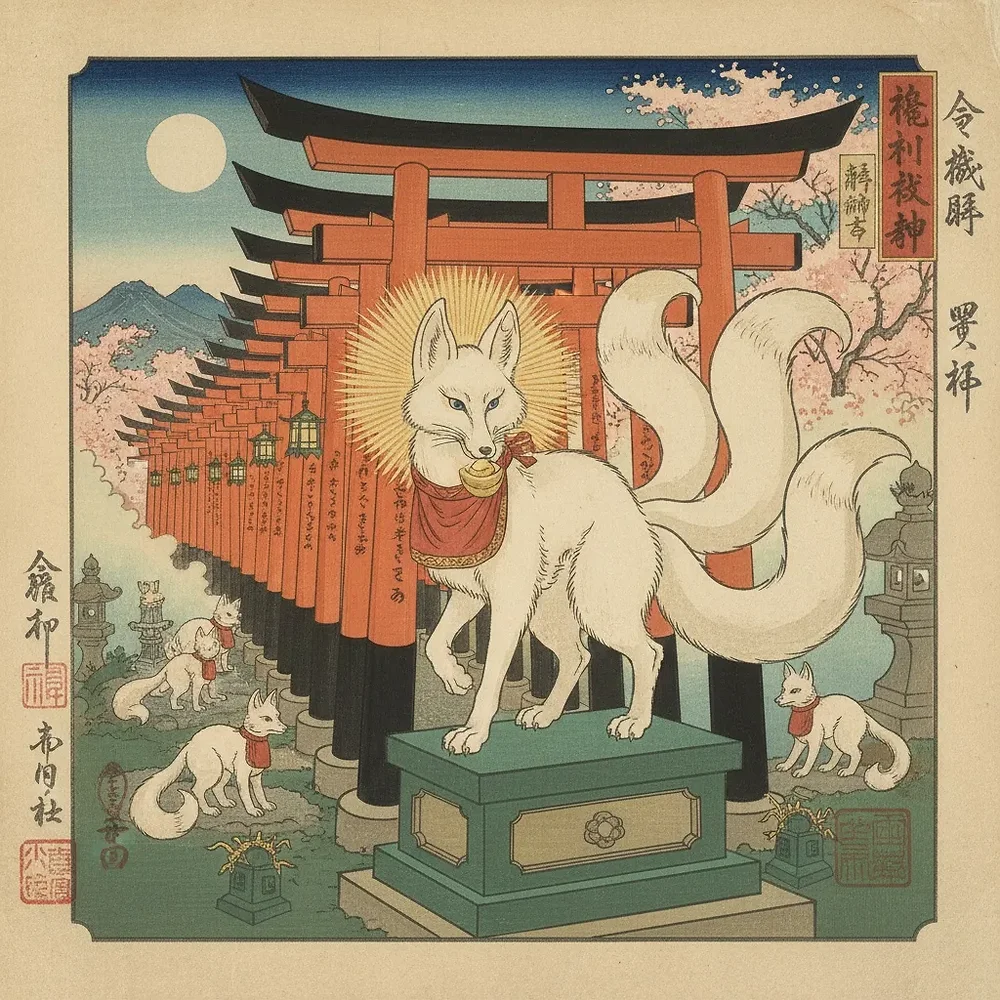
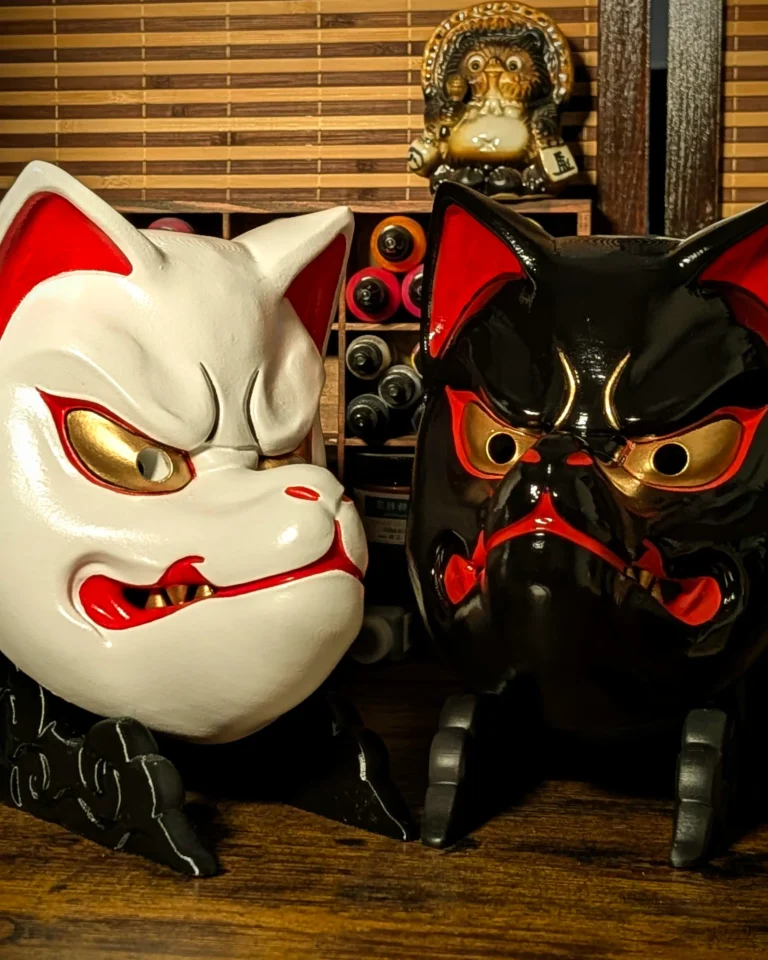
This is the commonest mistake in the folklore. The Kitsune (fox) is Inari's messenger, not Inari himself. The technical term is kenzoku (眷属), a spiritual servant: the fox carries humans' prayers to the kami, it doesn't grant them. The confusion comes from the fox statues guarding every Inari shrine's entrance. You see the fox and think it's the god, but that's confusing the postman with the sender. Inari's foxes are always white (byakko, 白狐), often wear a red scarf, and hold one of these objects in their mouth:
- A granary key (kagi): access to the rice stores and to wealth. - A jewel ball (tama, 玉): Inari's spirit, supernatural power. - A sutra scroll: wisdom, sacred knowledge. - A sheaf of rice: fertility and abundance.
The object in the fox's mouth tells you which aspect of Inari the shrine mainly venerates.
Why the fox?
The association wasn't mystical to begin with, it was practical. The old Japanese observed that foxes came down from the mountains in spring, at rice-planting season, and went back up in autumn after the harvest. Above all, the fox hunts the rodents that devour stored grain: it was the invisible guardian of the rice. In 711, the first Inari shrine was raised on Mount Inari in Kyoto, and the fox officially became the kami's messenger. Peasant observation became religion.
30,000 shrines and 10,000 torii
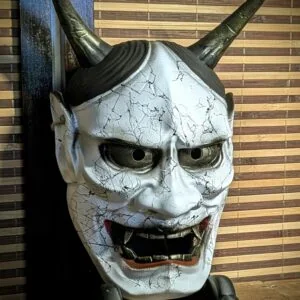
The Inari network is the densest in the country. The best known, Fushimi Inari-taisha in Kyoto (founded 711), lines up over 10,000 red torii across four kilometres along Mount Inari, each donated by an individual or company in thanks, bearing the donor's name and date. The vermilion (shu) isn't decorative: it symbolises vitality and protection from evil, the same logic as the red Oni masks and Hannya. Red, in Japan, repels as much as it attracts.
Zenkō and Nogitsune: the fox's dual status
The fox is a yokai of dual status depending on whether it serves Inari. When it serves the kami, it's a Zenkō (善狐), a celestial white "good fox." When it acts alone and plays tricks, it's a Nogitsune (野狐), a "wild fox." Same creature, two behaviours depending on whether it's inside or outside the divine chain. That chain runs higher still: Amaterasu introduces rice, Inari protects it, the Kitsune carries the prayers. For the wider view, see the kami guide.
FAQ
Is the Kitsune Inari?
No. The Kitsune is Inari's messenger (kenzoku), not the kami himself. The confusion comes from the fox statues guarding Inari shrine entrances. It's like confusing the postman with the sender.
Is Inari male or female?
Both, and neither. Depending on shrine and era, Inari appears in male form (a bearded old man), female form (Dakiniten on a white fox), or as a collective of five kami. It's a force that adapts to the worshipper.
Why are Inari's torii red?
The vermilion (shu) symbolises vitality, protection from evil and sacred power. The Fushimi torii are donated by individuals and companies in thanks to the kami, each gate bearing the donor's name.
How many Inari shrines are there in Japan?
Over 30,000, about a third of all Shinto shrines in the country. The most famous is Fushimi Inari-taisha in Kyoto, founded in 711, with its 10,000 red torii.