The Oni have a king. Not some vague elder or honorary title, but a true sovereign, with a palace on a mountain, an army of demons and a reputation that made the Kyoto court tremble in the 10th century. His name, Shuten-dōji (酒呑童子), means "the sake-drinking boy," a misleading nickname for one of the Nihon Sandai Yōkai, the three greatest yokai of Japan, alongside the nine-tailed fox Tamamo-no-Mae and the tengu emperor Sutoku. His story is probably the most complete Oni legend there is: tragic origin, reign of terror, fall through betrayal.
Read the article about Oni masks · See Oni masks
Born human, turned monster
Unlike the Oni born in hell to torment souls, Shuten-dōji was a boy, and a boy so beautiful that every woman fell in love with him. He rejected them all and burned their letters unread. In the most common version, the smoke of those letters, charged with the spite of the rejected women, corrupted his soul. Another version, more telling for a mask maker, says he put on an Oni mask at a festival to frighten people, and when the festival ended the mask would not come off: the leather had fused with his flesh, the horns had pierced his skull. His inner cruelty had caught up with his appearance. Rejected by humans, he fled into the mountains to become what he already looked like.
Mount Ōe, palace of iron and blood
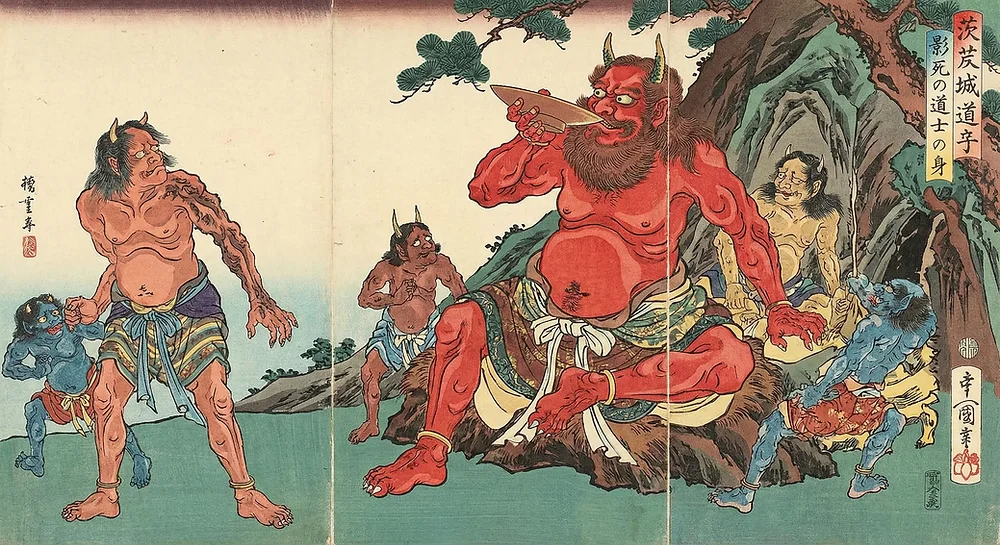
Shuten-dōji settled on Mount Ōe, near Kyoto, with an army of bandits and yokai, including his right hand Ibaraki-dōji. From there his demons came down by night into the capital to kidnap nobles, steal treasures and, the texts say, drink the blood of the living like wine. His nickname comes from his weakness: sake. Invincible in combat, able to lift boulders, he grew careless when he drank. And he drank a great deal.
Raikō's trick
The emperor sent Minamoto no Raikō (Yorimitsu), Japan's greatest warrior, to deal with the problem. Raikō knew he couldn't win a head-on fight, so he resorted to cunning like Odysseus. He and his four lieutenants, the Shitennō including the famous Watanabe no Tsuna, disguised themselves as wandering monks, hid their weapons in bamboo backpacks and climbed the mountain. Confident in his power, Shuten-dōji invited them to his banquet and offered them human flesh and blood, which the samurai pretended to eat. In return, Raikō offered the demon a "divine" sake, in fact the Shinpen Kidoku-shu, a poison given by the gods: a tonic for humans, a paralytic that cancels the Oni's magic. Shuten-dōji drank whole barrels and fell asleep.
The samurai put on their armour, entered the sleeping king's chamber, and Raikō cut off his head with his sword Dōjigiri Yasutsuna, "the demon cutter." The severed head, mad with rage, flew up and bit Raikō's helmet, shrieking that demons, at least, do not lie, unlike humans. The helmet held, and Raikō survived.
Who is the real monster?
The legend raises the question, deliberately or not. Shuten-dōji welcomes strangers, offers hospitality and shares his meal; in return the "heroes" lie, drug him and murder him in his sleep. In modern readings, Shuten-dōji is often seen as an anti-authority figure, the king of outsiders, of those who live beyond the suffocating rules of the court. That's why he appeals to rebels and tattoo artists. Sake also carries symbolic weight: in Shinto it links humans to the gods, and by drinking endlessly Shuten-dōji seeks a near-divine trance.
How to recognise him
What sets a Shuten-dōji apart from a classic red Oni is excess. Where a standard Oni has two horns, Shuten-dōji often bears five, like a natural crown, and his fangs jut from the mouth in disorder. His expression isn't just anger but arrogance, the sidelong smile of one who knows he's king. In depictions he holds a giant sake gourd (hyōtan) in one hand and an iron-spiked club (kanabō) in the other.
FAQ
What's the difference between Shuten-dōji and a Hannya?
The origin. The Hannya is a woman transformed by romantic jealousy, mixing sorrow and rage. Shuten-dōji is a man transformed by pride and spite, all power and arrogance. A tragic female demon against a male demon king.
Why does he have red or white hair?
In kabuki he wears a red wig for wild vitality. In modern anime the hair is often white to contrast with the red skin and mark his thousand-year age.
What is his weapon?
A giant sake gourd (hyōtan) in one hand, an iron-spiked club (kanabō) in the other.
Where do you place a Shuten-dōji mask at home?
Above an entrance door, since his severed head kept biting in the legend, using his ferocity as a guardian. Above a bar or wine cellar, the most fitting spot for the patron of drinkers.