A fine mask poorly displayed loses half its effect. The mount, the height, the light and the placement matter as much as the piece itself. This practical guide answers the real questions: wall or stand, at what height, how to light it so the relief comes alive, and where to place a mask by type. Concrete advice, not decor theory.
Read the article about Oni masks · See Oni masks
Wall or stand: which to choose?
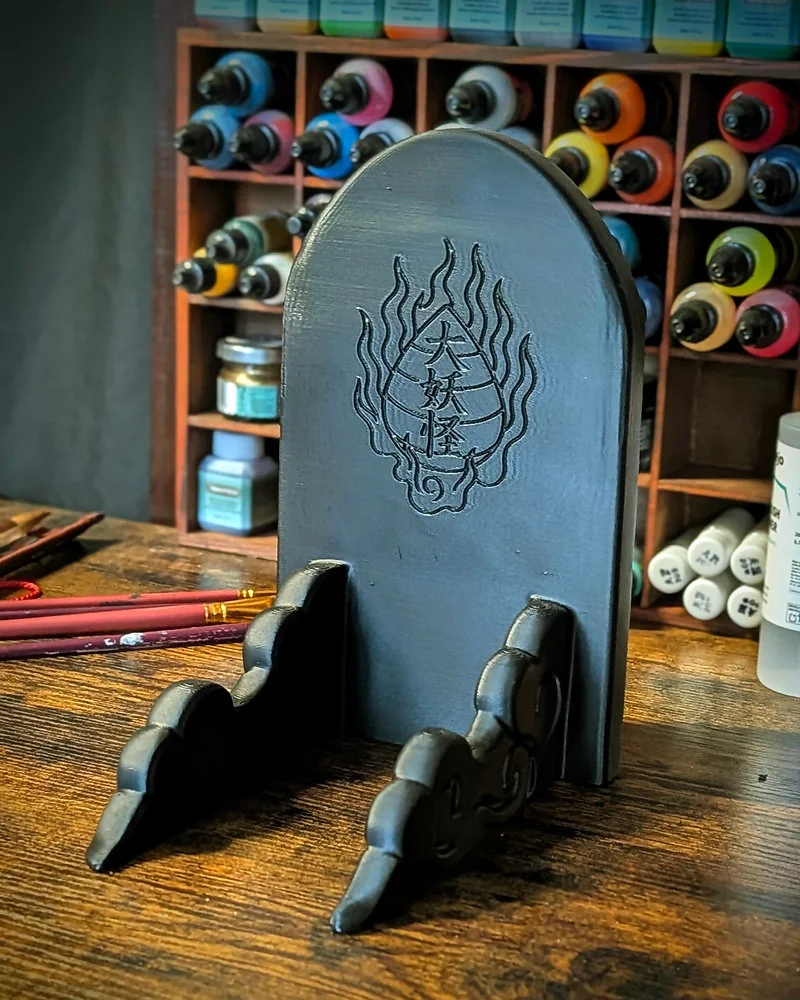
Both work, but not for the same effect. Wall mounting puts the mask at eye level, like a face watching over the room. It's the most natural option for a mask, and the closest to its guardian function, like the onigawara on roofs. A stand (or tabletop support) suits a piece you want to pick up, turn and move, and fits on a shelf or desk. Dai Yokai masks are hollow at the back with a built-in hanging system, so they're ready to hang directly; a small clear support is enough for the standing version.
The right height
The commonest mistake is hanging too high. A mask ideally sits at the eye level of a standing person, roughly 150 to 160 cm from the floor to the centre of the mask. At that height you meet its gaze and the sense of presence works fully. Above furniture (a dresser, a sideboard), leave about twenty centimetres between the top of the furniture and the bottom of the mask so it can breathe. For a gallery wall of several pieces, align the centres rather than the edges, since masks aren't all the same size.
Lighting, the detail that changes everything
This is what separates a mask that "sleeps" from one that lives. The light must come from the side or below, never from the front: frontal light flattens the volumes, while raking light carves the shadows under the horns, the eye sockets and the fangs.
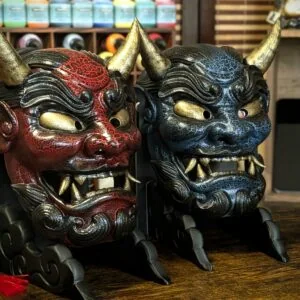
- Adjustable spot at 30-45°: the most effective way to reveal the relief. - Warm light (2700 K) on pale or traditional masks: it warms the white and gold without distorting them. - Raking LED from below on dark pieces (black Oni, Hannya Berserk): it throws the horns' shadows upward for a dramatic effect.
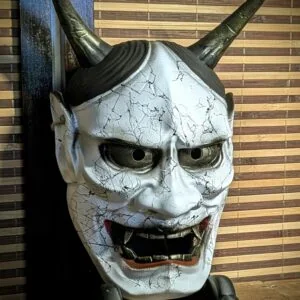
A black mask in a dark room disappears: it needs light to exist.
Where to place it by mask type
Each mask has a spot where its meaning carries fullest.
| Mask | Ideal spot | Why | |------|------------|-----| | Oni | Facing the entrance or a window | Its guardian role, like the onigawara | | Hannya | Under side or shifting light | Activates the expression that changes with the angle | | White Kitsune | Bright room, main wall | The white catches light and becomes a focal point | | Black Kitsune, dark pieces | Dark wall, LED setup | The dark ground brings out gold/silver accents |
Care and longevity
A displayed mask asks little: regular dusting with a dry microfibre cloth, no products. Avoid direct sun behind glass, whose concentrated UV can dull the surface over years. PETG doesn't yellow and varnish protects the paint, but prolonged direct light remains the enemy of any painted piece. To go further on integrating a mask into a whole room, see the article on Japanese decor.
FAQ
At what height should you hang a Japanese mask?
At the eye level of a standing person, roughly 150 to 160 cm from the floor to the centre of the mask. Above furniture, leave about twenty centimetres of space below the mask.
How do you light a mask so it stands out?
With side or bottom light, never frontal. An adjustable spot at 30-45° carves the shadows under the horns and sockets. Warm light (2700 K) for pale masks, raking LED for dark pieces.
Stand or wall mount?
Wall mounting puts the mask at eye level and suits its guardian role. A stand suits pieces you want to handle or place on a shelf. Dai Yokai masks have a built-in wall hanger.
Where do you place an Oni mask at home?
Facing an entrance or a window, where its guardian role makes full sense, like the onigawara on temple roofs. The wall you see first when entering is the ideal spot.