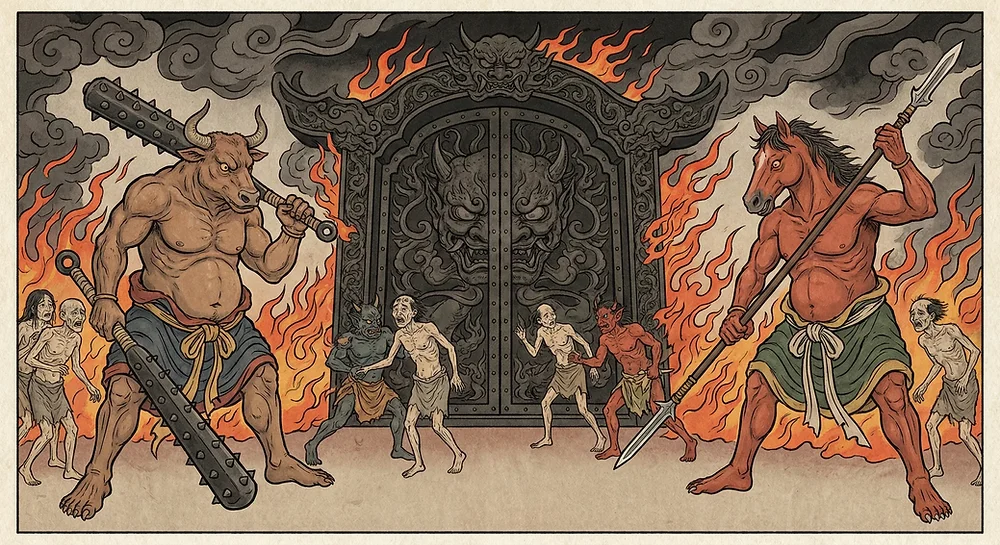
In Japanese folklore there are the demons who invade our world to spread chaos, like Shuten-doji, and there are those who wait for us to come to them. Gozu and Mezu are the second kind. If you've ever seen a depiction of the Japanese Buddhist hell (Jigoku), you've met them: two colossi flanking the throne of the great judge Enma. They conquer nothing, they punish.
Read the article about Oni masks · See Oni masks
Ox head, horse head
Gozu (牛頭) is the ox-headed demon, Mezu (馬頭) the horse-headed one. They're almost always shown together, massive muscular human bodies topped with an animal head. Gozu embodies brute force and crushing weight; Mezu, speed and the hunt, the one who runs down souls trying to flee. Between them they form hell's executive arm: where judge Enma passes sentence and the clerks record sins, Gozu and Mezu carry it out.
Officials who came from China
Like many Buddhist figures, Gozu and Mezu aren't a purely Japanese invention: they travelled from China with Buddhism. There they're called Niu-Tou (ox head) and Ma-Mian (horse face), messengers of the underworld (Diyu). Their original role wasn't only to torment but to fetch the souls of the dying and escort them to the court of the dead. Incorruptible, they can't be bargained with. In Japan they became the direct servants of Enma, king of the hells, and stand for the inescapable consequence of karma.
The impassive face of justice
What makes Gozu and Mezu so striking is their lack of human expression. They torment neither out of sadism nor pity: they apply a sentence the way one carries out a task. That animal neutrality is more disturbing than cruelty, because it offers no handle. You can't move them to pity or provoke them. They embody a mechanical justice, a consequence rather than a vengeance, and that's what sets them apart in oni folklore.
FAQ
Who are Gozu and Mezu?
The two guardians of the Japanese Buddhist hell, serving judge Enma. Gozu has an ox head, Mezu a horse head. They escort the souls of the dead and carry out sentences. They are officials of the afterlife, not worshipped gods.
Where do Gozu and Mezu come from?
From China, with Buddhism. There they're called Niu-Tou (ox head) and Ma-Mian (horse face), messengers of the underworld who lead the souls of the dying to the court of the dead.
Are they yokai or gods?
More like hell guardians, a class of demons serving Enma. They aren't kami worshipped in shrines: they're respected out of fear, as the embodiment of the consequences of karma.
Why a horse head for Mezu?
The horse is the animal of travel, traditionally linked to the idea of a guide of souls. Mezu represents the final journey, the one from which there's no return, and it's he who runs down souls trying to escape.