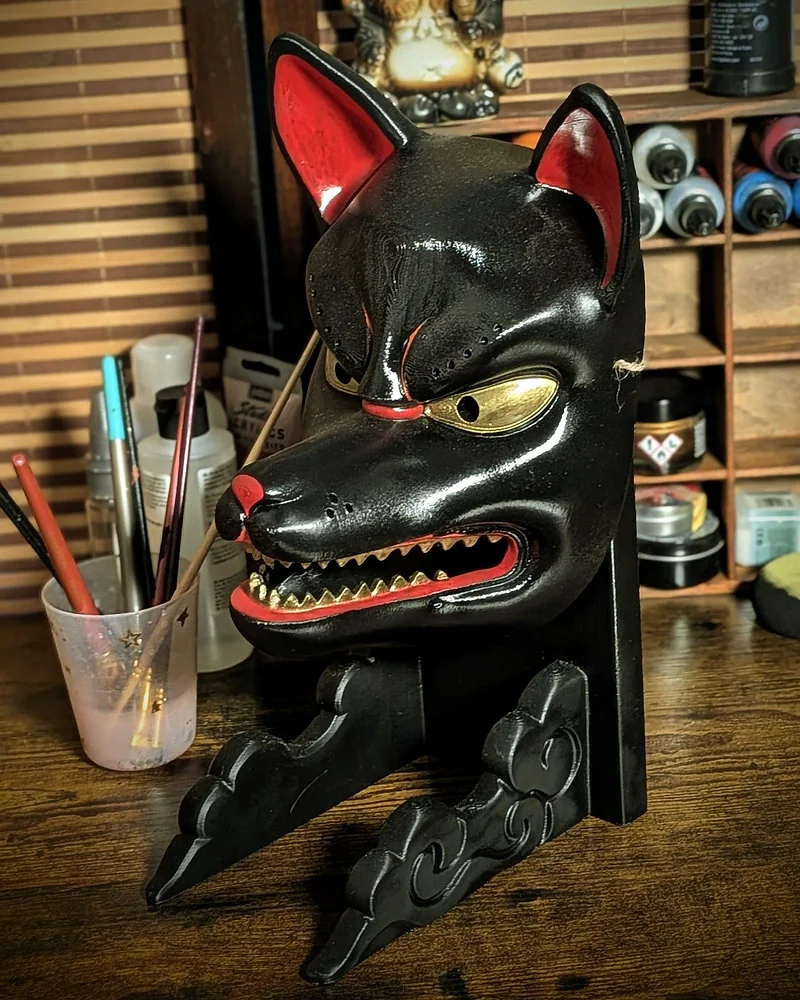
In the West, we link black to evil. Japanese folklore doesn't work that way. The black Kitsune, the Genkō (玄狐), isn't an evil fox: it's a sign of peace, a stellar guide, and the nocturnal counterpart of the white fox in Inari's court. The image of the demonic black fox comes from recent pop culture, not the old texts. Here's what the sources actually say, the Genkō's link to the stars, and why it breaks the usual codes.
Why the black Kitsune isn't a demon
Black (kuro), in Japan, is the colour of depth and the cosmos, not of malice. The Shoku Nihongi, an imperial chronicle of the 8th century, records that the appearance of a black fox heralded a reign of peace, the sign that the emperor ruled with wisdom. It's a detail that flips Western intuition: in tradition, the Genkō is a good omen. The dark, unsettling fox is a modern invention, carried by video games and anime, not the original folklore.
Read the article about Kitsune · See Kitsune masks
The link to the stars
This is the least-known side of the Genkō. In Onmyōdō, Japan's esoteric cosmology, the black fox embodies the Big Dipper (Hokuto Shichisei) and the Pole Star. It guides sailors and lost souls through the night. Black ties it to the North, to water and deep calm, the exact opposite of what you'd imagine from a dark mask. Where the white Byakko is solar, the Genkō is stellar.
Byakko and Genkō: Inari's pair
Inari is mostly associated with the white fox, but the old texts describe a divine pair: a white, solar fox and a black, nocturnal one. Together they represent the balance the fields need for fertility, a yin-yang where white is the visible active and black the silent deep.
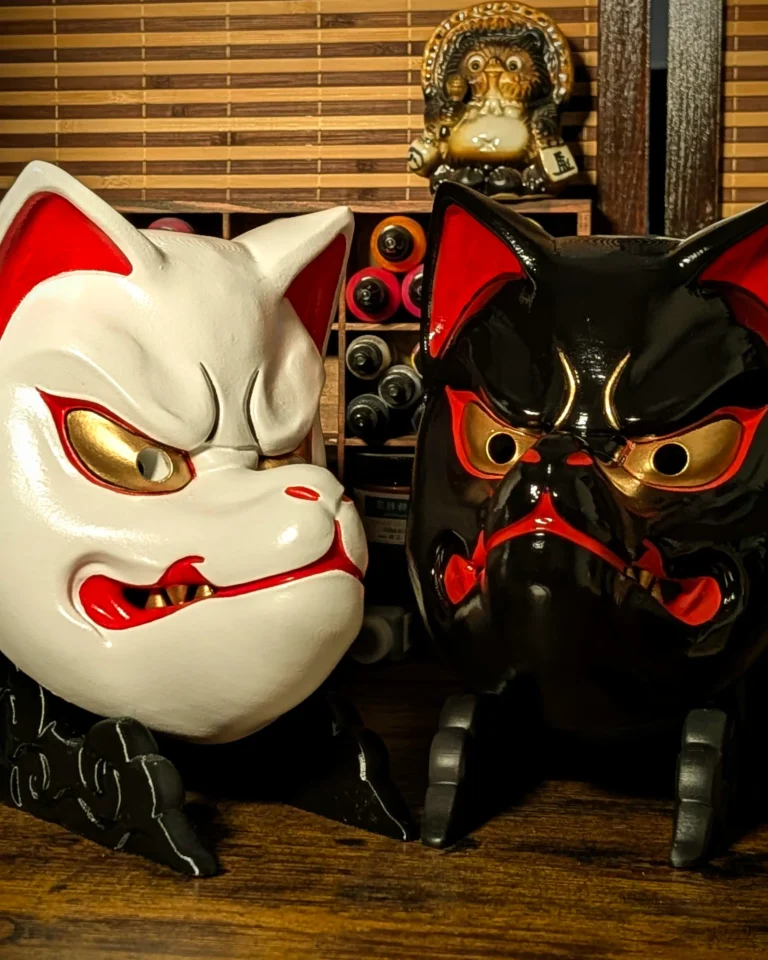
| | Byakko (white) | Genkō (black) | |---|---------------|---------------| | Star | Sun, day | Pole Star, Big Dipper | | Meaning | Purity, prosperity, prayer | Peace, stability, cosmic mystery | | Polarity | Yang (active, visible) | Yin (deep, silent) | | Interior | Bright, japandi, zen | Dark, modern, industrial |
Many collectors take both, day and night.
The Genkō today
The black Kitsune mask has taken hold in techwear, gothic and cyberpunk styles: it shows a link to Japan while stepping away from the classic red-and-white codes. Black serves as the base, and gold or silver accents catch the light. It's also a piece that stands out from the usual red in a tattoo studio, and the natural complement to a white fox to form the day/night duo.
Painting a black that doesn't look plastic
Painting a mask pure black is the surest way to make it look like a toy: flat black absorbs light and crushes the volumes. It all comes down to texture. A velvet matte black, built from several matte acrylic coats then a matte varnish, gives a fur-like look that lives in low light. A satin black, closer to Japanese lacquer (urushi), reflects just enough to reveal the face's ridges without the mirror effect of gloss. On black, the red kumadori reads poorly: gold (recalling the divine) and silver (recalling the stars) work far better. Black PETG holds up to 70 °C without warping, where PLA softens at 55 °C in direct sun, a real advantage for a mask worn at summer conventions.
FAQ
Is the black Kitsune evil?
No. In traditional folklore, the Genkō is a symbol of peace and good government, attested from the 8th century. It's recent pop culture that gave it the role of antagonist.
What's the difference from the white Kitsune?
The white (Byakko) is solar, tied to prosperity and the day. The black (Genkō) is stellar, tied to the Big Dipper and the Pole Star. The two form a yin-yang pair.
Can you wear it for cosplay in summer?
Yes. PETG holds up to 70 °C, so a black mask won't warp in direct sun, unlike PLA. Plan shade breaks for comfort.
Which accents work best on black?
Gold and silver. The red kumadori reads less well on black. Gold brings luxury, silver the cosmic feel. Both are available to order.