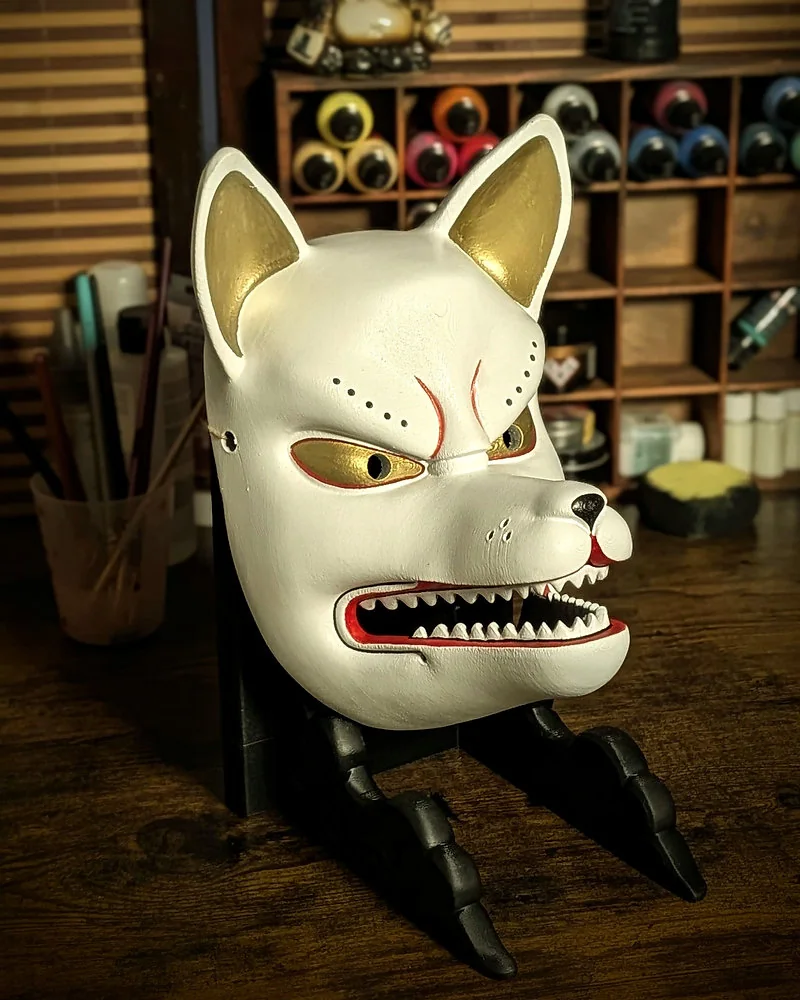
The white Kitsune mask isn't just another fox. White here isn't a decorative choice: it's the colour of the sacred in Shinto, the colour of the Byakko (白狐), the purest form of the fox, direct messenger of the deity Inari. Understanding why white matters so much is grasping what separates a celestial Kitsune from a plain field fox. Here's the symbolism of the Byakko, the fox-wedding legend, and the meaning of the red marks on white.
Why white is sacred in Japan
In Shinto, white (shiro) isn't the absence of colour but the colour of what doesn't belong to the visible world. Kannushi priests wear white, the paper streamers (shide) marking sacred spaces are white, and the stone foxes guarding Inari shrines are white too. A Kitsune mask painted white carries this code: it depicts a fox that has left the earthly world to join that of the kami. It's not a red field fox stealing hens, it's a celestial being.
What is the Byakko?
Folklore distinguishes two kinds of fox: the Zenkō (善狐), the good fox tied to Inari, and the Yako (野狐), the wild trickster fox. The Byakko is the ultimate form of the Zenkō. By tradition, a fox only turns white after living several centuries and gathering great wisdom. Linked to the sky and the stars, unlike the earth-bound red fox, it's a sign of great fortune: glimpsing one foretells a happy event. That's why white fox statues guard the entrance of the Fushimi Inari-taisha in Kyoto.
The fox-wedding legend
The phenomenon of rain falling while the sun shines is called in Japan Kitsune no Yomeiri (狐の嫁入り), "the fox's wedding." Legend holds it's the only time white foxes celebrate their nuptials: they use the rain to hide from human eyes while keeping the sun. Several festivals re-enact the scene, like the Ōji Kitsune no Gyōretsu in Tokyo on 31 December, where participants march in silent procession behind serene white fox masks.
Read the article about Kitsune · See Kitsune masks
Red on white: a code, not an ornament
The vermilion lines on a white Kitsune aren't decorative. In kabuki theatre, these marks (kumadori) emphasise the animal's senses: around the eyes spiritual sight, on the muzzle the nose for detecting the supernatural, in the ears the listening to prayers. The red-on-white contrast creates the visual vibration typical of Japan, the same as the Hinomaru flag, at once energetic and calming.
In decor and in making
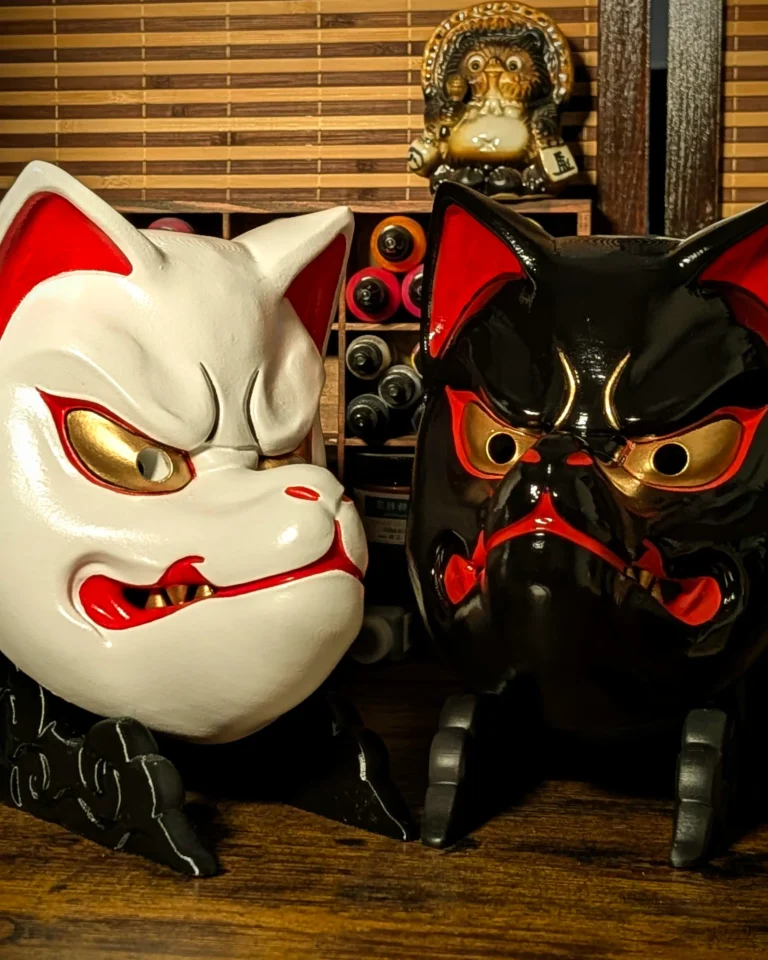
The white Kitsune is the most versatile of the range. It fits a japandi interior (neutral tones, pale oak) as well as a focal point in a modern living room, and catches the faintest light in a dark room. Two Kitsune facing each other, one white and one black, create a yin-yang effect. In the workshop, white is the least forgiving colour: white PETG throws back the light and reveals every print line, which demands heavy sanding (grits 120, 240, 400) up to a porcelain finish before painting, about 30% more time than a dark mask. PETG has the advantage of not yellowing over time, unlike cheap resins. The Byakko's nocturnal counterpart, the black Kitsune Genkō, completes the pair.
FAQ
Does white mean death in Japan?
White is tied to mourning, but above all to rebirth and the sacred. It's the colour of the passage to the other world, not a sad colour. A white Kitsune mask is a spiritual object, not a morbid one.
Is it the same mask as in Demon Slayer?
Sabito and Makomo's masks in Demon Slayer are protective masks in the white Kitsune style, symbols of purity of intent. It's the same cultural archetype, adapted for the manga.
What's the difference between the traditional and modern white Kitsune?
The traditional one bears the classic red kumadori marks (eyes, muzzle, ears). The modern one is more pared back, white-dominant with minimal accents. Both exist in the shop.
How do you care for a white Kitsune mask?
A dry microfibre cloth is enough for dusting, with no chemicals. Avoid prolonged exposure to direct sun behind glass: concentrated UV can dull the surface over the long term.