Watanabe no Tsuna (953-1025) is a warrior of the Heian period, famous for cutting off an oni's arm at Kyoto's Rashomon gate. He's one of the great demon-slayers of Japanese folklore, and his story shows the Oni mask from another angle: not the monster alone, but the figure that takes on full meaning against the one who faces it. The same scene told from the demon's side is in the article on Ibaraki-doji.
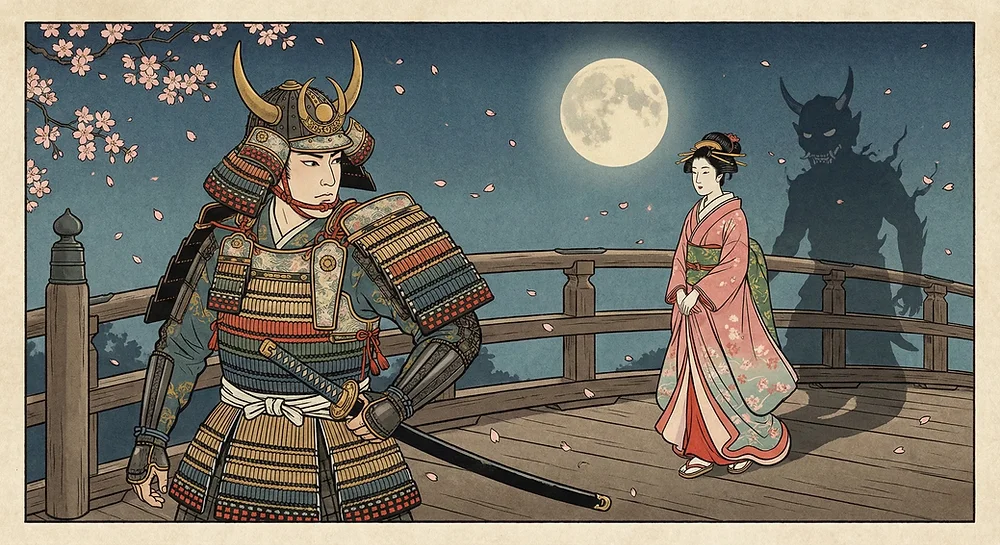
Kyoto at night, in the Heian era
In the Heian period, Kyoto, then Heian-kyō, is the capital of peace, but that peace is only a façade. People firmly believed that once the sun set, the city belonged to the spirits, the hour of the "night parade of a hundred demons." Bridges, crossroads and old gates were crossing points where one might be carried off by an oni. In that climate the Minamoto clan rose as the force able to protect the emperor, from human rebels and supernatural threats alike. Its leader, Minamoto no Raikō, was surrounded by four elite lieutenants, the Shitennō, among them Watanabe no Tsuna, the sword specialist, known for his absolute composure.
The Rashomon gate
The founding act of the myth begins with a drunken dare. One stormy night, Raikō and his lieutenants discuss the rumours around the Rashomon gate, Kyoto's vast ruined south gate, where a demon is said to devour travellers. Tsuna, without a word, dons his armour and rides off to plant an amulet there as proof of his visit. As he fixes it, a giant clawed hand descends and seizes him by the helmet to lift him into the air. Where most would freeze, Tsuna draws his sword and strikes on instinct, upward. The blade meets flesh, a scream tears through the thunder, and the demon flees, leaving its arm cut clean off behind it. It was Ibaraki-doji, lieutenant of the oni king Shuten-doji. Tsuna picks up the arm, locks it in a chest and goes home.
From the Higekiri sword to the Onikiri sword
In Japanese folklore the sword is a character in its own right. Tsuna's was first called Higekiri, "the beard-cutter," because a test on a condemned man had sliced through neck and beard in one stroke. After the Rashomon feat it was renamed Onikiri, "the oni-slayer." That renaming transforms the object: no longer just a weapon against men, but a blade able to wound the supernatural. A sword identified with this story is kept and venerated today at the Kitano Tenmangu shrine in Kyoto.
Read the article about Oni masks · See Oni masks
The demon's return by trickery
Keeping a demon's arm is not without risk. Warned by a diviner (often identified as Abe no Seimei) that Ibaraki would return, Tsuna seals himself in for seven days, letting no one enter. On the seventh evening, his old aunt (or nurse) knocks at the door. He refuses at first, then yields out of filial piety, that supreme virtue. The old woman asks to see the famous arm; the moment the chest is open, her face twists, she reverts to Ibaraki-doji, seizes the limb and flies off through the roof. The lesson is clear: oni exploit emotional weaknesses, not just physical ones.
The "Watanabe privilege"
This legend left a very concrete trace. At Setsubun, on 3 February, the Japanese throw beans to drive out demons. But families named Watanabe are traditionally exempt: by belief, oni have kept a hereditary fear of the name since Watanabe no Tsuna, and flee at the mere sight of a "Watanabe" nameplate. The name works as an amulet. It's one of the most delightful details of Japanese popular culture.
FAQ
Did Watanabe no Tsuna really exist?
Yes. He was a real historical figure (953-1025), a samurai of Musashi province and an ancestor of the Watanabe clan. The part with demons and severed arms is folklore (setsuwa), but the man and his sword were real.
How did Watanabe no Tsuna defeat the demon?
At the Rashomon gate, seized from behind by a clawed hand, he drew and struck upward on instinct, cutting off the demon's arm. The demon was Ibaraki-doji, Shuten-doji's lieutenant.
Why is the sword called Onikiri?
It was first called Higekiri, "the beard-cutter." After Tsuna cut off the demon's arm at Rashomon, it was renamed Onikiri, "the oni-slayer," a blade charged with power against the supernatural.
Why don't the Watanabe throw beans at Setsubun?
By popular belief, oni have feared the name Watanabe ever since Tsuna's feat. Watanabe families therefore don't need to drive out demons: their name alone is said to make them flee.