---
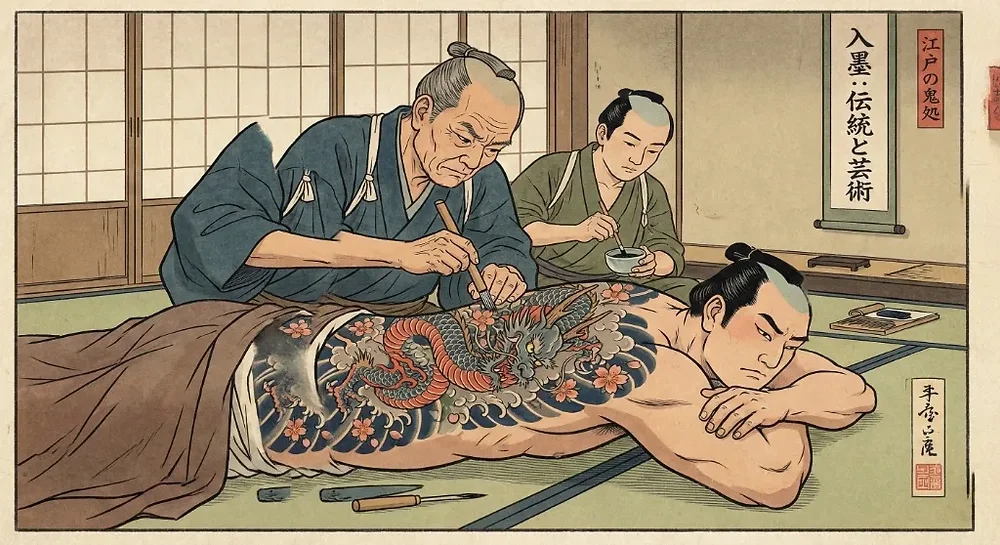
An Oni tattoo is a protection motif: in traditional Japanese tattooing, the Oni guards its wearer, it never turns on them. That's the short answer. The long answer is that a red, blue or black Oni each tells a different story, that the background decides whether your Oni is a guardian or just a floating mask, and that some pairings carry centuries of meaning. I make Oni masks for a living, a good share of my customers are tattoo artists, and these are the codes they work with.
Key takeaways
- Color is the first message: red = active guardian, blue = cold deterrence, black = the unseen
- Without a gakubori (background), an Oni loses most of its narrative power
- Oni + peony is the noblest pairing in irezumi: brutality balanced by honor
Does an Oni tattoo mean good or evil?
Protection, full stop. The confusion comes from the creature itself: in Japanese folklore the Oni is both the torturer of the Buddhist hells and the guardian of temple roofs. Tattooing follows the guardian logic. You put the scariest face on your skin so that nothing scarier dares approach. The same reasoning has kept Oni-faced tiles on Japanese temple roofs for centuries, and it's covered in depth in my Oni mask guide.
Read the article about Oni masks · See Oni masks
One thing the Oni tattoo is NOT: a yakuza marker. Irezumi carries that historical baggage, but the motif itself belongs to folklore, not to organized crime. Plenty of my tattoo artist customers work it into pieces for clients who simply want fourteen centuries of guardian mythology on their arm.
The gakubori rule comes first
Before color, before placement: the background. The most common Western mistake is an Oni inked alone on bare skin. In irezumi, the gakubori (額彫り) isn't decoration, it defines the world the creature lives in. Flames make it an active guardian. Waves make it a spirit of the deep. Clouds and lightning make it an elemental force. No background, and your Oni is just a mask floating in a void.
What each Oni tattoo color means
- Color: Reading in irezumi
- Red (Aka-Oni): The fighting guardian. Fire, passion, aggressive protection
- Blue (Ao-Oni): Cold deterrence. Water, depth, punishment by immersion in the Buddhist hell hierarchy
- Black (Kuro-Oni): Shadow and secrecy. It doesn't show itself, it acts
- Yellow/Gold (Ki-Oni): Wealth and authority. Punished greed, protected prosperity. Rare in the West
- White (Shiro-Oni): The most ambiguous. White touches mourning and the afterlife: a presence from elsewhere
Field notes: pure black works best on large surfaces, where deep shading builds a dimension color doesn't always reach. White is mostly used as highlights over dark backgrounds, for the spectral effect.
Classic pairings and what they say
- Oni + Peony (botan): The noblest combination. The peony tempers brutality with honor: force and grace in balance
- Oni + Flames: Purifying destruction. The Oni doesn't burn, it controls. Channeled violence
- Oni + Hannya: The ultimate duality: raw masculine force, transformed feminine grief. Both faces of anger
- Oni + Snake (hebi): Total danger. Doubly protected territory, doubly dangerous
- Oni + Raijin / Fujin: Thunder and wind framing the ogre: maximum power composition
- Oni + Cherry blossom (sakura): The strongest contrast in irezumi: brutality against fleeting beauty
- Oni + Dragon Ryū: Combined powers. Earth and fire meet water and sky. Monumental pieces only
Composition detail worth knowing: Oni and Hannya never face each other in mirror symmetry. In irezumi, the two masks look at each other at an angle, in tension, not in symmetrical confrontation.
Where to place an Oni tattoo
- Full sleeve: the natural home for a single Oni with background. Mask on the biceps or forearm depending on orientation.
- Full back: for double compositions (Oni + Hannya, Oni + Dragon, Oni + Raijin/Fujin), mask in the high dominant position.
- Thigh: ideal for a mid-size Oni with peony. Less exposed, more intimate, holds detail well.
- Chest: visually strong for asymmetrical compositions.
- Calf: compact Oni, minimal background. Popular in neo-traditional work.
Why tattoo artists buy physical masks
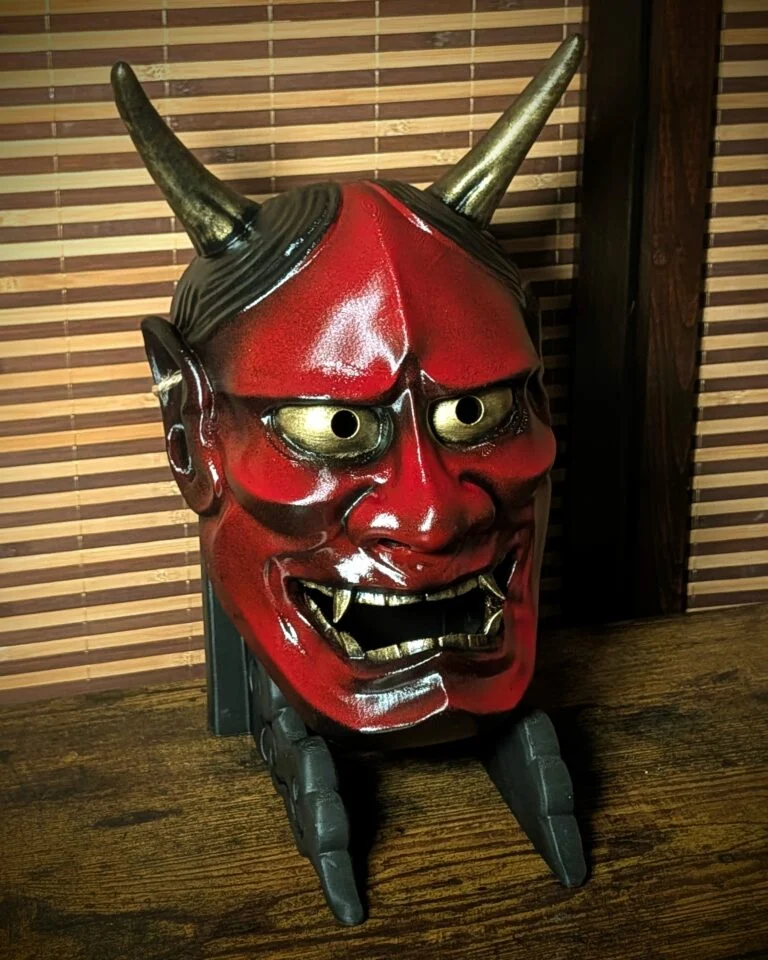
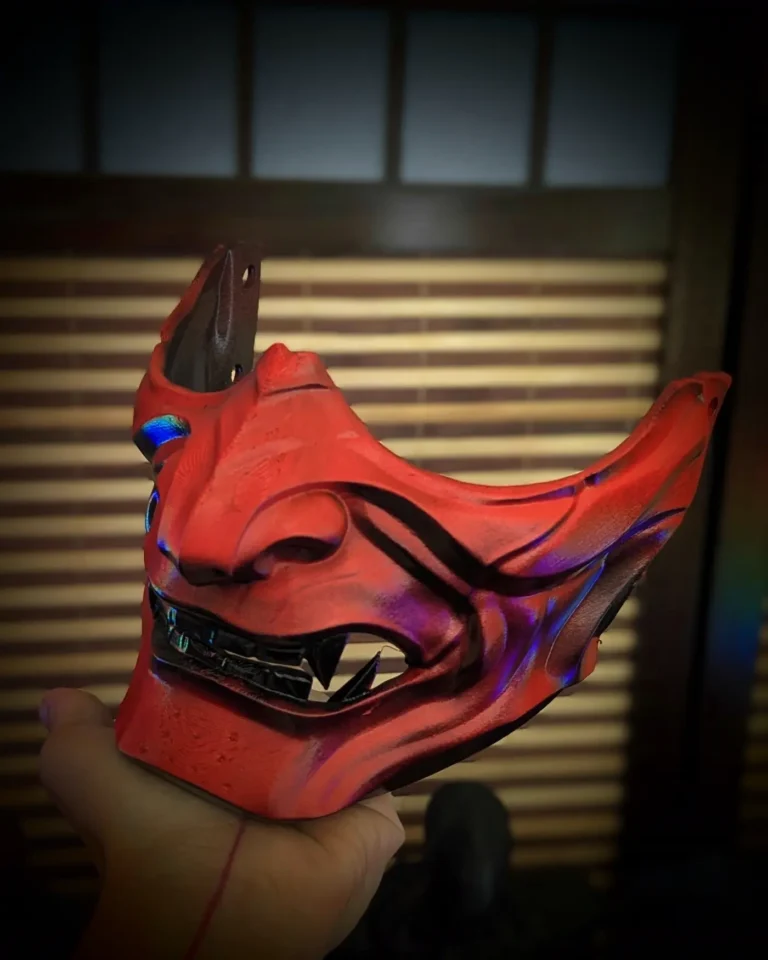
A flat reference photo gives you one angle. A physical mask gives you real shadows from every direction, the horn curvature in perspective, what the snarl does when the surface bends. That's why tattoo artists are one of my main customer groups: they keep a mask at the station as a 3D composition reference for pieces that have to wrap around a moving arm.
Full disclosure on my own ink: my irezumi was done by machine, not tebori. I don't have the patience for the traditional hand-poked method, and I own that. It changes nothing about the motif codes, which haven't moved since the Edo period (1603-1868). Technique evolves; the visual grammar doesn't.
Every mask in my Oni collection is made to order in my workshop in Brittany, France: 3D printed in PETG, hand-sanded for 3 to 5 hours, painted in acrylics, sealed with matte varnish, shipped tracked worldwide. The Mempo half-masks (100 to 160 g) are the format artists prefer on the work station.
FAQ
What does an Oni tattoo symbolize?
Protection. In irezumi, the Oni shields its wearer from misfortune and bad influences, following the Japanese guardian logic: adopt something scarier than whatever might harm you. The color then refines the message, from aggressive red to secretive black.
Is an Oni tattoo disrespectful?
Not inherently. The Oni is a folklore figure, not a religious icon, and guardian Oni imagery is everywhere in Japan, from temple roofs to festival masks. Respect comes from getting the codes right: a coherent background, meaningful pairings, and a composition that follows irezumi grammar rather than fighting it.
Do Oni and Hannya work in the same tattoo?
Yes, and it's one of the most powerful irezumi compositions. The Oni is masculine and active, the Hannya feminine and emotional: together they show both forms of anger and transformation, usually across a full back, looking at each other at an angle rather than head-on.
Does an Oni tattoo need a background?
In traditional irezumi, yes: the gakubori defines the creature's world. In contemporary styles, a backgroundless Oni can work if the composition is designed for that absence, not left empty by default. If the mask seems to float on the skin, the background is missing.
What's the difference between an Oni tattoo and a Hannya tattoo?
The Oni is an ogre born supernatural: raw force, fixed rage, short thick horns, a guardian. The Hannya is a human woman transformed by jealousy: fine horns, an expression that shifts with the angle, a warning. Two opposite stories on the same skin.
---