In Japan, the wolf was never the beast to be killed of European tales. The Ōkami (狼) was instead a protector, a guardian of the mountains and a messenger of the gods. That special place comes down to a quirk of language that shaped everything: the word for "wolf," ōkami, is a homophone of ōkami (大神), the "great god." From that play on sound grew a reverence that still survives at certain shrines.
Read the article about Kitsune · See Kitsune masks
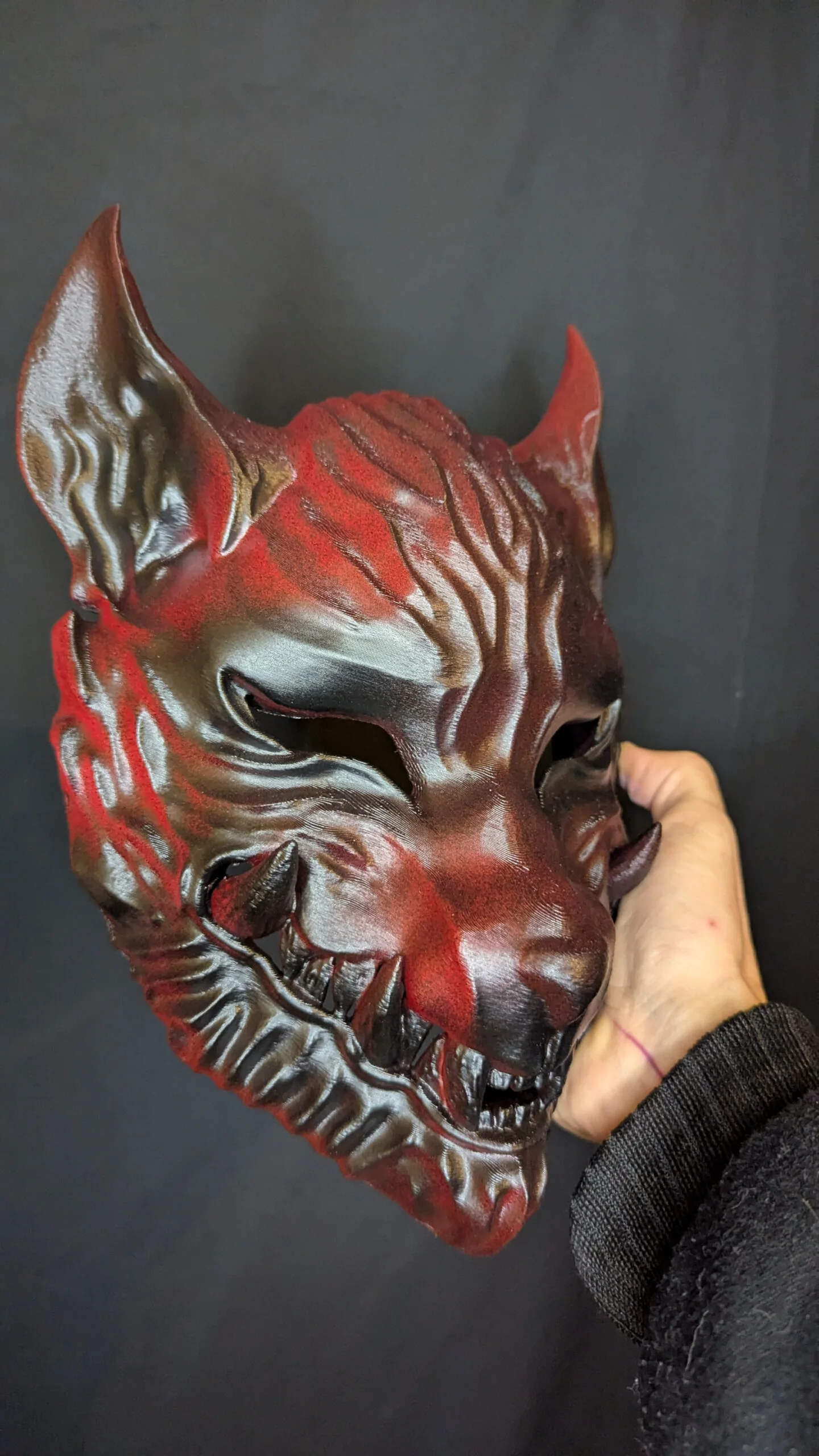
Workshop note: at Dai Yokai, I use the Ōkami motif as a starting point for a handmade PETG mask, printed, sanded, painted and varnished in my workshop in Brittany, France. The aim is not to reproduce a ritual object, but to make a wearable or display piece that keeps the protective spirit of the wolf.
The mountain guardian
In Japanese folklore, the mountain is a place apart, dangerous, the domain of the mountain god, the Yama-no-Kami. The wolf is seen as his helper, because it did the farmers a very concrete service: it hunted the deer and boar that ravaged the crops. That role of crop protector turned a predator into an ally, then into a sacred figure. It was also invoked against fire and theft, and several Shinto shrines made the wolf their otsukai, their messenger to the kami, as the fox is for Inari.
The wolf that walks you home
The most touching legend is that of the okuri-ōkami, the "escort wolf." By a widely held belief, a lone traveller crossing the forest at night might be followed by a wolf, not to attack but to quietly accompany them until they reached home safely. The wolf watched over them, and as long as it wasn't provoked, it did no harm. It's the exact opposite of the Western big bad wolf: here, the night-time animal is a four-legged guardian.
Mitsumine and the wolf shrines
This reverence has its strongholds. The most famous is Mitsumine shrine, in Chichibu (Saitama prefecture), where wolves, not the usual foxes or lion-dogs, guard the entrance. The wolf is worshipped there as a protector against fire, theft and misfortune. Other small wolf shrines exist on the Kii Peninsula. There you find the figure of Makami, the "true god," the name given to the deified wolf.
The Honshū wolf, gone but not forgotten
Behind the myth was a real animal: the Honshū wolf (Canis lupus hodophilax), a small grey wolf endemic to the Japanese islands. It is gone, the last known specimen recorded in 1905. Its disappearance paradoxically deepened its aura: freed from its reality as a predator, it became a symbol of lost wilderness. That charge is what modern works draw on, from the white wolf of Princess Mononoke to Atsu's wolf companion in Ghost of Yotei, where the animal evokes both the nature of Ezo and the spirits of folklore.
FAQ
What does the wolf represent in Japanese mythology?
The Ōkami is a protector, not an evil predator. A guardian of the mountains and helper of the mountain god, it hunted the deer and boar that destroyed crops, and was invoked against fire and theft. Several shrines make it a messenger of the kami.
Why does the word for wolf mean "great god"?
By folk etymology: ōkami (狼), the wolf, is a homophone of ōkami (大神), the "great god." That coincidence of sound fed the reverence of the wolf as a sacred figure.
What is the okuri-ōkami, the escort wolf?
A belief that a wolf might follow a lone traveller through the forest at night, not to attack but to escort them home, as long as it wasn't provoked. The wolf plays the role of a guardian.
Does the Japanese wolf still exist?
No. The Honshū wolf (Canis lupus hodophilax), a small grey wolf of the Japanese islands, is considered extinct since 1905. It survives as a symbol in folklore, in shrines like Mitsumine and in popular culture.