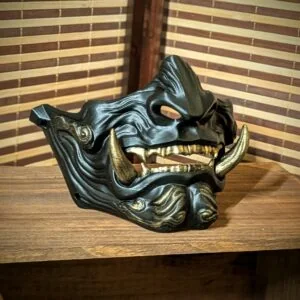
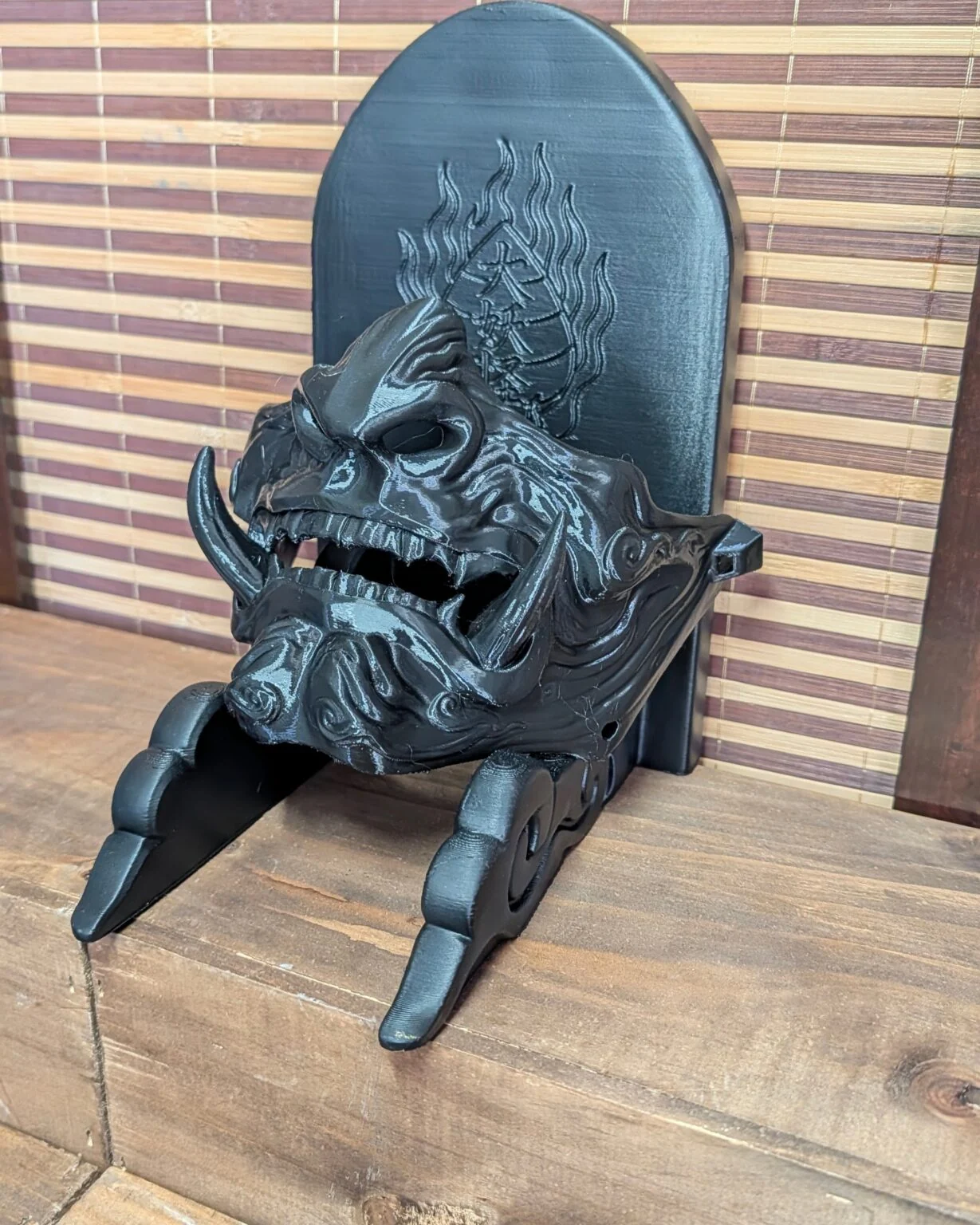
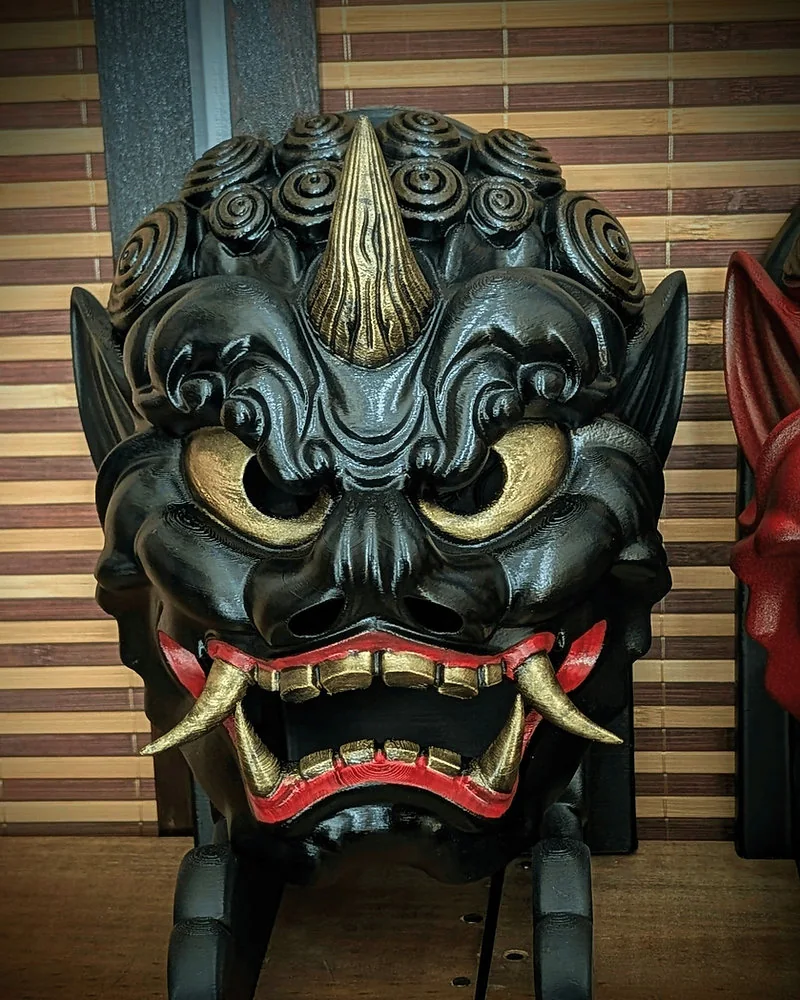
A black Oni mask (Kuro-Oni, 黒鬼) embodies doubt and ignorance, the root poison in Japanese Buddhism: the state of mind every other demon grows from. The red Oni screams. The blue Oni calculates. The black Oni does nothing. It just stands there, motionless, and that is exactly what makes it the most unsettling of the five.
In my workshop in Brittany, France, it is also the mask I find the most honest to make. No effects to hide behind. A good black Oni is volume, material and controlled light. Nothing else.
Key takeaways
- Black means doubt and ignorance, the root of the five Buddhist poisons.
- In the Buddhist hells, the black Oni is not the torturer: it is the silent guard of the deepest gates.
- Painting a black mask is a trap: you paint with blacks, never with one flat black.
The psychology: why people pick the black one
In my experience, customers who order a black Oni are the calm ones. It is not the mask you pick to impress at first glance; it is the one you pick because you have thought about it.
Black is the primal fear. Not the fear of being hurt, that is red territory, but the fear of vanishing, of being absorbed into nothing. Owning the mask is a way of taming that fear: I see the dark, I hold it in my hands, and it does not scare me anymore.
Jung called it the Shadow, the part of yourself you push down. The Kuro-Oni is its perfect archetype. Tattoo artists and martial artists who hang one in their studio are doing a quiet form of shadow work: acknowledging the dark part is the only way to become whole.
What black means in the five-Oni system
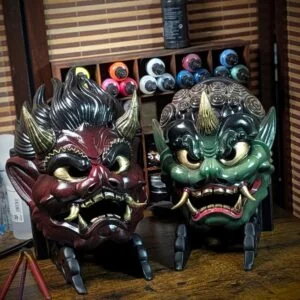
Japanese Oni follow a precise system, the Goshiki no Oni, where each color embodies a Buddhist hindrance of the mind: red for greed, blue for hatred, yellow for restlessness, green for torpor. The full system is in my Oni mask guide.
Read the article about Oni masks · See Oni masks
Black stands for doubt and ignorance. And in Buddhism, ignorance is not a lack of education: it is the inability to see the true nature of reality. The belief that the ego is permanent, that things are fixed.
It is because you are in the dark that you crave, hate and fret. The Kuro-Oni is the root. Without it, the other demons do not exist.
The silent judge of the deepest gates
If the red Oni is the torturer who strikes, the black Oni is the silent guard of the lowest gates. In the mythology, when you die and cross the Sanzu river, you stand before Enma-O, the great judge of the hells. His closest guards are dark Oni.
At Setsubun, in some old temples, the ritual includes a black Oni: the one that resists the thrown beans the longest. Doubt is an impenetrable armor.
How I paint black, and why pure black fails
Painting a mask black sounds simple. That is the trap. Lay pure black everywhere and the light gets swallowed, the details vanish, and the mask turns into a flat stain. All the sculpting work, gone.
My method is to paint with blacks, plural. The skin gets an ultra-matte black that eats light and creates the void. Horns and teeth go satin, with gold accents. Then a very light dry-brush of anthracite grey on the ridges, so the eye reads the volume without quite seeing it.
The gold on the horn tips is the classic black-and-gold contrast of Japanese art, kuro-kin, the one you see on samurai armor and lacquered bowls. Even in the deepest dark, a spark of the divine remains. It is the same idea behind Kintsugi, the gold that mends the cracks. I do Kintsugi-style gold lines on black masks as a custom option.
Material note: PETG matters for a black mask. Black surfaces heat up fast in direct sun; a PLA mask would soften around 60 °C and warp. PETG holds.
Where to display a black Oni mask
In Feng Shui, black belongs to Water and the North, the career and life-path sector. The north wall of an office or living room is the spot. Lighting is non-negotiable: a black mask in a dark corner visually disappears. One directional LED spot, gallery-style, changes everything.
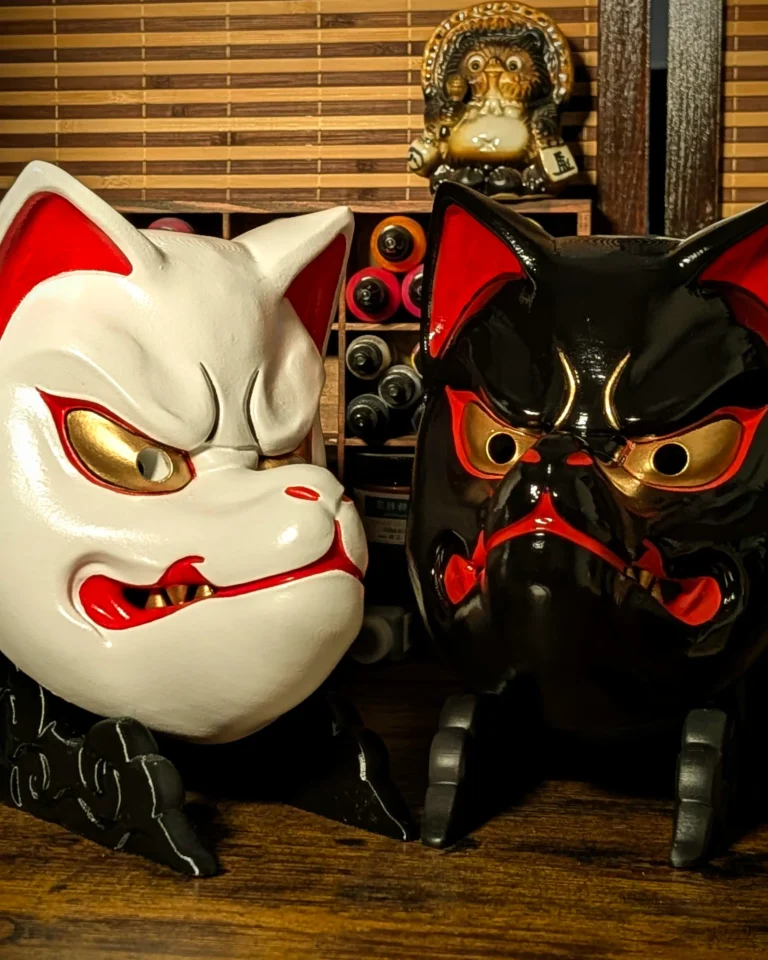
The pairing that works best: a Kuro-Oni next to a white Kitsune. Perfect yin and yang, the earthly demon and the celestial messenger. Every piece ships made to order, tracked worldwide, from my mask collection or my Etsy shop.
FAQ
What does a black Oni mask mean?
The Kuro-Oni embodies doubt and ignorance in the Buddhist five-Oni system. It is the root color: greed, hatred and restlessness all grow out of being in the dark.
Is a black Oni mask bad luck?
The opposite. Because it absorbs light, it is read as an absorber of bad energy, protecting like a dense spiritual shield.
What's the difference between a black Oni and a red Oni?
Red is the active torturer: fire, fury, aggressive protection. Black is the silent guard: it does not strike, it absorbs. Two guardian roles, two opposite energies.
What does a black and gold Oni mask mean?
It is the kuro-kin contrast of Japanese art, seen on samurai armor and lacquerware: even in the deepest dark, a spark of the divine remains. The same idea drives Kintsugi, where gold mends the cracks.
Where should I hang a black Oni mask?
On a north wall, linked to career and life path in Feng Shui, always with directional lighting: without light, a black mask vanishes visually. Pair it with a white mask for contrast.